
Your website is probably reaching global audiences earlier than you think.
A travel website launched in the UK may start attracting visitors from Europe and Asia within weeks. Similarly, an educational platform may begin seeing learners from multiple countries long before it officially expands internationally.
But scaling a website across languages is far more complicated than simply changing text. Businesses often struggle with inconsistent messaging, broken SEO structures, poor localisation quality and workflows – all of which become increasingly difficult to manage over time.
This is why more organisations now prefer to translate website with AI rather than relying entirely on manual localisation. Modern AI-driven workflows can preserve context, tone, structure and multilingual SEO. This further helps businesses scale global website experiences far more efficiently.
The business impact is also very critical. A global consumer survey found that 76% of online shoppers prefer purchasing when product information is available in their native language. Additionally, 40% never buy from websites that are not presented in their own language. (Source: CSA Research). Interesting, isn’t it?
In this blog, we will explore how businesses can translate website with AI more effectively. We will also look at the common challenges multilingual websites face and the strategies that help brands scale globally – all this without losing context, SEO performance, or brand consistency.

Website translation means adapting a website for different languages, regions and audiences. This is done while preserving its overall user experience and brand intent.
Many businesses still approach localisation as a simple language conversion task. In reality, website adaptation involves much more than translating visible text.
A multilingual website needs to preserve:
Without these elements, websites may technically support multiple languages while still feeling disconnected or unnatural to users.
A product page designed for UK audiences may not resonate the same way in Germany or the Middle East. Certain calls-to-action may feel overly direct in some regions. On the other hand – navigation patterns and purchase behaviour can vary depending on the audience.
This is why businesses rely on advanced website translation tools that process websites contextually rather than literally. The goal is not simply to make content readable in another language. Instead, to make the entire experience feel native to users in every market.
Search visibility also becomes a major factor during multilingual expansion. Localised URLs, metadata structures, hreflang implementation and regional keyword intent all influence whether a multilingual website performs effectively in search engines.
Without a proper localisation strategy, even well-designed websites struggle to build trust internationally.
Website localisation becomes significantly more difficult once businesses begin scaling content regularly across regions.
Traditional workflows are often fragmented. Teams manually export content from CMS platforms, adapt it separately, review pages individually and then re-upload updates across multiple language versions. While this may work temporarily for a few pages, the process becomes increasingly unsustainable as websites grow larger.
A multilingual website may involve:
Managing all of this manually creates operational bottlenecks very quickly.
Basic machine localisation introduces another layer of problems. Conventional systems process content sentence by sentence without understanding website-wide context. As a result, messaging becomes inconsistent across pages, product positioning weakens and customer journeys start feeling disconnected.
This is one of the key reasons businesses increasingly translate website with AI instead of relying on isolated automation systems.
SEO also becomes a major challenge during multilingual expansion. Many businesses unknowingly create duplicate content structures, incorrect indexing behaviour, or poorly implemented hreflang systems that damage search visibility internationally. Several conventional website translation tools still struggle to manage multilingual SEO properly at scale.
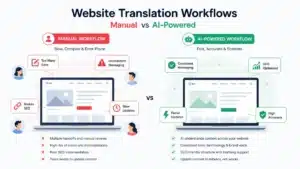
The financial impact of weak localisation is becoming increasingly measurable as well. A 2025 UK study estimates that language barriers, including poorly localised or untranslated customer experiences, lead to average annual losses of more than £300,000 per business. That roughly translates to over ₹3.4 crore in lost opportunities every year. (Source: Businessinfo)
For B2B and B2C businesses operating globally – websites are often the first interaction customers have with the brand. When messaging feels disconnected, confusing, or culturally misaligned, businesses risk losing conversions long before sales conversations even begin.
One of the biggest challenges is maintaining brand consistency across languages. Direct language conversion often removes the tone and nuance that made the website effective in the first place. Over time, this can weaken customer trust and impact conversions across markets.
The most effective multilingual websites are built using workflows that combine contextual adaptation, SEO alignment and scalable automation together.
If you are exploring how to translate a website into multiple languages effectively – the process should begin with understanding which parts of your website actually require localisation first. Not every page necessarily needs immediate multilingual deployment. Businesses usually start with high-impact pages such as core landing pages, product pages, pricing sections, onboarding flows and support resources.
The next step involves choosing target languages strategically based on traffic patterns, expansion priorities and customer demand. A SaaS company entering Europe may prioritise German and French first, while a travel platform may require broader multilingual coverage much earlier.
Once the target structure is defined – businesses can begin building scalable localisation workflows. This is where organisations increasingly translate website with AI rather than relying entirely on manual intervention.
Modern AI systems can preserve terminology consistency and adapt website structures – all this while reducing the overall operational effort.
Review still remains an important part of the workflow. Even advanced AI systems benefit from human validation for cultural phrasing and regional messaging nuances. The strongest multilingual websites combine AI scalability with strategic human oversight.
An eCommerce brand expanding into Japan may need far more than simple language adaptation. Product descriptions may require softer phrasing, promotional banners may need different urgency structures and trust indicators may need to be repositioned entirely for local buying behaviour.
In many cases, the visual presentation also changes. Some markets respond better to information-heavy layouts. Others prioritise cleaner and minimal browsing experiences. This is why the best way to translate a website accurately is not through direct conversion alone – but through contextual adaptation that aligns with regional expectations.
A SaaS company expanding internationally may encounter different localisation requirements altogether. European markets may require GDPR-focused messaging, while onboarding terminology may need to change depending on technical familiarity across regions.
Customer support structures, pricing communication, feature explanations and even navigation wording may require adaptation beyond language itself. Businesses increasingly use enterprise-grade website translation tools because these platforms can preserve terminology consistency while supporting scalable multilingual deployment.
This becomes especially important when websites are updated frequently across multiple regions simultaneously.
A healthcare platform expanding into multiple regions may need to adapt medical terminology, appointment flows and patient communication. All this needs to be based on local regulations and audience familiarity. Certain regions may prefer highly detailed informational content, while others prioritise simplified guidance and trust-focused messaging.
In such cases, businesses must translate website with AI to preserve clarity and contextual accuracy.
A real estate website targeting international buyers may require localisation beyond property descriptions. Measurement units, pricing presentation, neighbourhood references and investment terminology – all need regional adaptation to feel natural for different audiences.
Modern website translation tools help maintain consistency across listings, enquiry flows and multilingual property pages while supporting scalable global visibility.
Businesses scaling multilingual websites successfully usually follow structured localisation practices instead of treating adaptation as a one-time project.
Although multilingual automation has improved significantly, many website translation tools still struggle with contextual adaptation at scale.
One of the biggest weaknesses is literal conversion behaviour. Many systems generate outputs that are technically accurate but contextually weak because they fail to understand brand messaging, audience intent and page-level relationships across the website.
Another major limitation is scalability. Conventional tools often work reasonably well for static pages, but struggle with:
Several systems also lack proper multilingual SEO integration, which creates indexing issues and fragmented search visibility across regions.
This is why businesses prefer to translate website with AI using agent-driven workflows that combine contextual understanding with scalable automation rather than relying purely on traditional localisation platforms.
But before multilingual workflows start sounding overwhelming – park your worries because we have got you covered.
emotii Website AI Studio is designed specifically for businesses managing multilingual websites where communication quality, contextual accuracy and SEO integrity all matter equally.
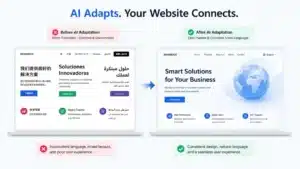
Instead of processing websites through direct language conversion alone, emotii adapts website content contextually while preserving brand tone, semantic meaning, cultural relevance and multilingual SEO structures. The platform is built to support scalable website localisation without compromising communication consistency across regions.
Businesses can translate website with AI across 126+ languages while maintaining:
This makes the platform especially valuable for businesses operating across global audiences. SaaS companies can manage multilingual onboarding more efficiently. Furthermore, eCommerce brands can scale international storefronts. It is also useful for travel platforms and enterprise websites handling multilingual communication across regions.
As businesses continue expanding globally, multilingual websites are becoming a critical infrastructure rather than an optional localisation project.
Traditional workflows remain slow, fragmented and difficult to scale effectively. Basic automation systems improve speed but still struggle with the deeper challenges multilingual websites introduce.
This is exactly why more businesses now translate website with AI instead of relying entirely on disconnected manual workflows or basic machine localisation systems.
AI-powered localisation workflows are making multilingual websites much easier to manage at scale. This is done while keeping the communication quality across markets intact. Platforms like emotii Website AI Studio help organisations move beyond direct language conversion and towards multilingual digital experiences that feel locally relevant, contextually accurate and structurally consistent everywhere.
If your business is scaling across regions, multilingual communication can no longer remain an afterthought. The faster brands adapt their websites for global audiences, the easier it becomes to build trust and grow across markets with consistency.