
AI translation has improved dramatically over the past few years. What once produced awkward, word-for-word translations can now generate content that reads surprisingly naturally – in multiple languages!
That progress has made platforms like DeepL a popular choice for businesses expanding internationally. Whether it is translating website copy, product catalogues, marketing emails or internal documentation – organisations increasingly rely on AI translation software to reach customers. This is done across multiple markets faster than ever before.
According to Nimdzi’s 2025 Language Technology Atlas, businesses are rapidly increasing investment in AI-powered translation technologies. This is being done to manage growing multilingual content demands. At the same time – the volume of digital content requiring localisation continues to rise – across ecommerce, SaaS, customer support and global marketing. (Source: Nimdzi)
But one important question remains: how accurate is DeepL – and is that level of accuracy enough for business communication?
Translation quality today isn’t measured only by whether individual words are correct. Businesses need content that preserves brand voice, reflects local culture, supports multilingual SEO and delivers a consistent customer experience – across every touchpoint.
In this guide, we will take an objective look at DeepL accuracy and where the platform performs exceptionally well. Furthermore, we will also explore where it still has limitations and why many organisations are moving beyond translation – towards context-aware multilingual communication.
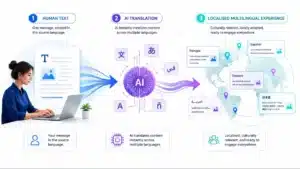
DeepL is an AI-powered neural machine translation platform – launched by the German company DeepL SE in 2017. It quickly gained recognition for producing translations that often sound more natural than traditional machine translation systems.
Today, DeepL supports dozens of languages across text translation, document translation and writing assistance. Businesses use it for:
Unlike older statistical translation systems, DeepL uses neural machine translation (NMT). Rather than translating words individually – NMT analyses complete phrases and sentence structures to generate more fluent output.
Over the years, DeepL has expanded its capabilities with:
These improvements have positioned it as – one of the strongest AI translation software platforms available today – particularly for European languages.
However, while DeepL excels at producing natural-sounding translations – businesses evaluating how accurate is DeepL for websites need to look beyond linguistic quality alone. Website localisation introduces additional challenges. These often include SEO, cultural adaptation, user experience and brand consistency – that extend far beyond language conversion.
DeepL’s reputation didn’t develop simply because it translates quickly. It became popular because: many users noticed that its output often sounded closer to something written by a native speaker.
Several factors contribute to its strong reputation:
Instead of translating every sentence literally – DeepL analyses surrounding words to understand how ideas connect. For example, the English word “bank” could refer to a financial institution or the side of a river. DeepL generally performs well at selecting the correct meaning – based on surrounding context rather than translating both possibilities identically.
This contextual understanding makes translations feel significantly more natural than older machine translation systems.
DeepL is particularly recognised for translations involving:
Independent evaluations have consistently shown strong performance across these language pairs. This is because DeepL has invested heavily in linguistic quality for European markets.
Businesses operating primarily within Europe – often find DeepL translation accuracy sufficient for many day-to-day business tasks.
One noticeable difference between DeepL and many traditional translation engines is: sentence flow. Rather than producing rigid word-for-word output – DeepL frequently restructures sentences to match how native speakers naturally communicate.
For marketing content, emails and product descriptions – this often creates translations that require fewer grammatical corrections.
DeepL has also gained popularity among professional translators. This is not achieved as a replacement for human expertise – but as a productivity tool. Many language professionals use it to create an initial draft before refining terminology, tone and cultural nuances.
This hybrid workflow allows translators to work faster – while maintaining high-quality standards.
Like most modern AI platforms – DeepL continues improving through ongoing model development. Recent updates have focused on:
These advances explain why DeepL consistently appears in discussions comparing DeepL vs Google Translate and other AI translation software.
However, strong translation accuracy should not automatically be confused with complete localisation capability.
A customer support conversation or global marketing campaign requires far more than grammatically correct language – which is exactly where the discussion becomes more interesting in the next section.
DeepL has earned a strong reputation for producing natural-sounding translations. But accuracy isn’t the same across every language. If you are evaluating how accurate is DeepL for your business – it is important to look beyond individual sentences – and consider how the translated content performs in real-world scenarios.
Let’s break it down!
One of the biggest factors affecting DeepL translation accuracy is the language pair you’re working with.
This is where DeepL consistently performs at its best. Languages such as English, German, French, Spanish, Dutch, Italian and Portuguese – generally produce highly natural translations with good grammar and sentence flow.
For example – translating a French product description into English usually requires minimal editing before publication.
DeepL has expanded support for languages including – Japanese, Korean and Chinese. Additionally, the quality has improved considerably over recent years.
However, these languages often involve different sentence structures, levels of formality and cultural nuances – making translation more complex.
A Japanese customer support response – for instance – may require different levels of politeness depending on the audience. This is something AI may not always interpret perfectly.
Accuracy can vary more noticeably for languages with fewer training resources or regional variations. Businesses targeting niche or emerging markets should plan for additional review – particularly when translating customer-facing content.
Good translation is about more than converting one sentence at a time. The surrounding context often changes the meaning entirely.
DeepL performs very well when translating individual sentences. Simple marketing copy, FAQs, emails and product information are usually translated clearly – while preserving readability.
Things become more challenging when meaning depends on multiple paragraphs. Imagine a software landing page where the same feature is described differently across several sections. If each paragraph is translated independently – terminology may become inconsistent.
While DeepL performs better than many basic translation tools in maintaining continuity – longer documents may still benefit from human review.
Tone is one of the hardest aspects of language for AI. Consider these examples:
The literal meaning may remain correct across all three – but the emotional impact can vary significantly after translation. This becomes especially important when – businesses rely on a consistent brand voice across global markets.
DeepL generally performs well with structured business content – but technical industries introduce additional complexity.
It handles many common business documents successfully, including:
However, highly specialised terminology often requires review. Industries such as healthcare, legal services, pharmaceuticals, engineering and finance – frequently use terms where even small translation differences can change meaning.
For example – a medical device instruction translated literally could create confusion or regulatory issues – if terminology is not validated by subject-matter experts.
Independent research consistently ranks DeepL – among the strongest machine translation platforms – particularly for European languages. Studies by the European Commission’s Directorate-General for Translation and Intento highlight its fluency and contextual accuracy – across many language pairs. (Source: European Commission Report )
However, performance still varies depending on the language pair, content type, industry terminology and available context. While DeepL performs exceptionally well for business documents and marketing content – multilingual websites, ecommerce and regulated industries often require broader localisation beyond translation.
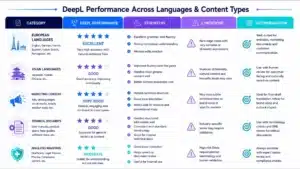
For many everyday business scenarios – DeepL can significantly reduce the time spent on manual translation. All this is done while maintaining high-quality output.
Some of its strongest use cases include:
Reports, presentations, proposals and internal documentation – all these generally translate very well. This is especially true between major European languages.
Businesses creating multilingual websites often use DeepL to generate an initial draft before localisation and quality review. For informational pages and blogs – this can dramatically reduce turnaround time.
Large ecommerce catalogues – containing thousands of product listings – can be translated much faster using AI than through entirely manual workflows. Teams can then focus their review efforts on high-priority products.
DeepL performs well for straightforward marketing content. These include newsletters, landing pages and promotional emails.
However, campaigns relying heavily on humour, emotion or local cultural references usually benefit from additional refinement.
Many organisations use DeepL for:
Here, speed is often more valuable than perfect stylistic nuance.
For multinational teams communicating daily across languages – DeepL offers a fast and practical way to understand and respond to emails. This is achieved without lengthy delays.
DeepL delivers excellent translations – but businesses expanding globally often need capabilities that go beyond translation alone.
DeepL translates content well but doesn’t adapt the overall website experience – including navigation, CTAs and user journeys – especially for different markets.
It doesn’t localise keywords or search intent – making additional optimisation necessary for strong multilingual SEO performance.
Maintaining a consistent brand tone across multiple languages requires contextual oversight – which is beyond automated translation.
Support interactions depend on context and cultural expectations – where direct translations may not always feel natural.
Industries like healthcare, finance and legal services require highly precise terminology. These should always be validated by experts.
A common misconception is that better translation automatically creates a better multilingual experience. In reality – translation is only one part of localisation.
| Translation | Localisation |
| Converts words into another language | Adapts the complete customer experience |
| Focuses on linguistic accuracy | Focuses on cultural relevance and business outcomes |
| Works sentence by sentence | Considers the entire page and user journey |
| Doesn’t optimise for multilingual SEO | Includes local keywords, hreflang and search intent |
| May preserve wording | Preserves meaning, intent, brand voice and conversions |
Imagine a UK retailer expanding into Germany.
Translation changes: “Free delivery on orders over £50.”
Localisation considers much more:
The words are only one small part of the experience. This is why businesses comparing DeepL vs Google Translate increasingly ask a different question altogether:
“How do we create multilingual experiences that feel native – not simply translated?”
That’s where context-aware AI localisation platforms begin to offer a significant advantage – especially over standalone translation tools.
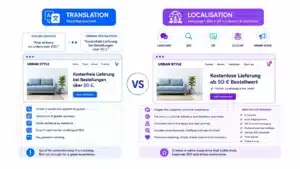
Translation is only one part of multilingual communication. Businesses also need to preserve intent, maintain brand consistency, adapt to cultural expectations and scale across multiple channels – all while keeping workflows efficient.
This is where platforms designed for contextual multilingual communication make a significant difference.
Rather than focusing solely on text translation – emotii offers a suite of AI-powered products that help organisations communicate naturally across languages. All this is done while preserving tone, meaning and cultural relevance.
If your goal is to expand into new markets – emotii Website AI Studio goes beyond basic AI website translation.
Instead of translating pages one by one, it interprets your entire website – from headers and navigation menus to CTAs and product pages – while preserving:
It also supports 126+ languages, offers plug-and-play deployment, handles hreflang implementation and enables businesses to launch multilingual websites – without disrupting existing workflows.
Video content introduces another layer of complexity. Subtitles alone rarely create an engaging viewing experience.
emotii Video AI Studio adapts videos into 70+ languages – while maintaining synced speech, natural expressions and contextual meaning. This makes product demos, training videos and marketing campaigns feel native to every audience.
PowerPoint presentations often lose formatting during translation. emotii Presentation AI Studio converts presentation decks into 126+ languages – while preserving layouts, fonts, visuals and overall design. This reduces the need for manual formatting after translation.
Global collaboration depends on real-time understanding. emotii Meetings enables participants to speak naturally – while conversations are interpreted in 70+ languages, complete with transcripts, meeting summaries and recordings.
Similarly, emotii Conference allows organisers to host multilingual events. This is where attendees can listen and interact in their preferred language – without interrupting the speaker.
Businesses serving international customers also need multilingual conversations that sound natural. With emotii Chatbot, AI-powered responses preserve tone, intent and cultural context – instead of producing literal translations.
For organisations building multilingual products – emotii API for Text and emotii API for Voice embed contextual language intelligence directly into websites, applications and customer experiences.
Across every product, emotii follows the same principle: translate the meaning – not just the words.
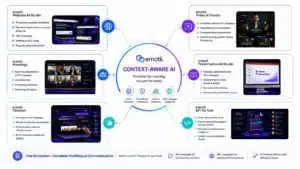
DeepL works best when it’s part of a broader localisation workflow rather than the entire workflow itself.
For many European language pairs – independent evaluations generally find DeepL produces more natural and fluent translations than Google Translate. However, performance varies depending on the language, content type and use case. Both platforms continue to improve through ongoing AI model development.
DeepL can produce high-quality translations for: website content, particularly informational pages and product descriptions. However, website localisation also involves multilingual SEO, user experience, navigation, cultural adaptation and brand consistency – which require more than translation alone.
Yes – DeepL works well for business documents, emails, presentations and marketing content. Businesses operating in regulated industries or managing multilingual customer experiences – should still include review and localisation workflows. This is to ensure accuracy and consistency.
DeepL often produces natural-sounding language – but maintaining a consistent brand personality across multiple languages. This usually requires contextual review, terminology management and localisation guidelines.
Translation converts content into another language. Website localisation adapts the complete user experience – including language, SEO, imagery, UX, cultural references, payment information and conversion messaging – for each target market.
DeepL has earned its reputation as one of the most accurate AI translation platforms available today. For business documents, marketing copy, emails and many European language pairs – it consistently delivers natural, fluent translations that can significantly reduce manual effort.
However, as businesses grow internationally – translation becomes only one part of the challenge.
Creating multilingual websites, customer experiences and marketing campaigns requires: contextual understanding, cultural adaptation, SEO optimisation and consistent brand communication – areas where translation alone cannot deliver the complete solution.
This is where context-aware AI platforms become increasingly valuable.
By combining multilingual intelligence with tone preservation, cultural awareness and scalable workflows – emotii helps organisations communicate confidently. This is achieved across websites, meetings, presentations, videos and customer interactions. Instead of managing multiple disconnected translation processes – businesses can create multilingual experiences that feel authentic in every market.
If your organisation is evaluating the best DeepL alternative for businesses or looking beyond standalone translation tools – adopting a context-first multilingual communication strategy can help you scale globally. Here’s the best part: all of this can be done without compromising on quality, consistency or customer experience.