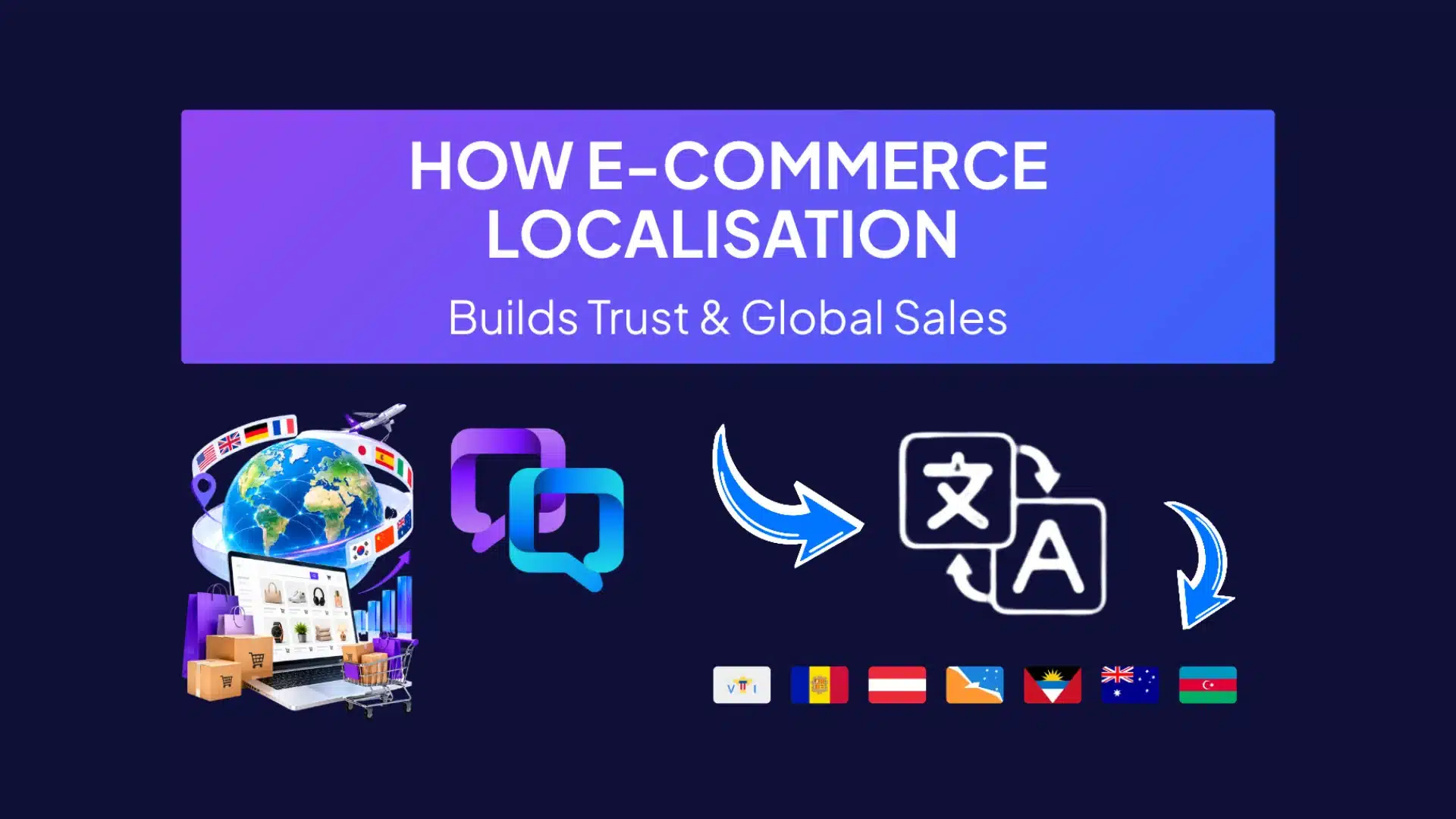

Global e-commerce is making international markets more accessible than ever. A brand can launch in a new country without opening a physical store there. This is done while customers can discover products from retailers thousands of kilometres away.
The opportunity is significant. According to DHL’s 2026 E-Commerce Trends Report, 70% of shoppers globally buy from retailers outside their home country. About 45% do so at least once a month. The report also found that 63% of global businesses adapt their online stores with local languages and currencies for the markets they serve. (Source: DHL 2026 E-Commerce Trends Report)
Yet entering a market is easier than earning trust in it.
Customers want to understand what they are buying, how much it costs, when it will arrive and what happens if something goes wrong. They also expect the experience to feel familiar. That includes language, currency, payment methods, product information, delivery details & customer support.
This is where e-commerce localisation becomes important. Localisation goes beyond translating website copy. It means adapting the shopping experience to the expectations of a particular market. Done well, it can reduce friction, make a brand feel more credible & help customers make purchase decisions with greater confidence.
For e-commerce businesses expanding internationally, localisation is therefore becoming part of the growth strategy itself.
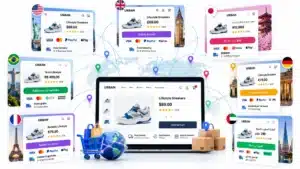
E-commerce localisation is the process of adapting an online shopping experience for customers in a specific market.
Translation is one part of it. The wider process can include product content, website navigation, pricing, currencies, payment methods, marketing, customer support, delivery information, cultural preferences and regional requirements. Consider a fashion brand entering Germany, Japan and the UAE. The products may remain largely the same. The experience around those products will probably need to change.
Product descriptions may require different terminology. Measurements may need to follow local conventions. Prices need to appear in the appropriate currency. Payment preferences can vary. Delivery and returns information may need to reflect local expectations. Even campaign messaging may need to be adapted to fit the market.
The objective is to make the brand feel relevant to customers in each region without losing its overall identity.
Product information is one of the most important localisation touchpoints. A direct translation can communicate the basic meaning of a description. This is done while still sounding unnatural or confusing to a local customer.
Product names, specifications, measurements, materials, colours, sizes and usage instructions – all of them may require adaptation.
For example, a clothing brand may need different sizing conventions across markets. A cosmetics company may need to adapt ingredient information and product claims. A food retailer may need to present allergen information according to local requirements. These details may seem small. But they influence whether customers feel confident about what they are buying.
Localisation also extends to the wider website experience. Menus, category names, search filters, FAQs, checkout instructions and support pages should all make sense to local users.
Dates, addresses, measurements and other conventions may also need to change.
A website can technically be available in another language. However, it can still feel like an overseas website. Awkward phrasing, inconsistent terminology or untranslated sections – all of them can quickly expose that gap. For an international customer, these details can affect perceptions of professionalism and trust.
Customers should not have to calculate what a product will actually cost them. Displaying prices in the local currency makes the shopping experience easier to understand. It can also help customers compare products more naturally.
The same applies to taxes, duties, delivery charges and other costs. Transparency is particularly important in cross-border e-commerce because unexpected costs can create hesitation at checkout.
Payment preferences vary between markets. A customer may be comfortable paying by card in one country. But he may prefer a digital wallet, bank transfer or another local option elsewhere.
Offering familiar payment methods can reduce friction at checkout. The wider lesson is that localisation should consider how customers complete a purchase. It should not just focus on how they browse a product.
Marketing content often requires more adaptation than product descriptions.
A campaign that performs well in one country may not have the same impact elsewhere. Cultural references, humour, imagery, seasonal events and promotional language – all of them can influence how an audience responds.
The objective is not to create an entirely different brand for every market. Instead, brands need to preserve the core message. This is done while adapting how it is expressed locally. This applies to paid advertising, email campaigns, social media, influencer content, landing pages and video.
International customers need clear information about fulfilment.
How long will delivery take? Are duties included? Where can an order be returned? Who pays for the return? How long will a refund take?
These questions can directly influence the purchase decision. Localising delivery & returns information makes the process easier to understand. It can reduce uncertainty before checkout. This is also an area where operational localisation matters as much as language.

Trust is one of the biggest challenges in cross-border e-commerce. Customers may recognise the product. But still hesitate to buy because the retailer is unfamiliar. They may worry about payment security, delivery, returns or customer support.
A localised experience can remove some of those concerns.
Customers are more likely to feel comfortable when the shopping experience follows familiar conventions.
Local language, currency, payment options, delivery information and terminology can make an international retailer feel more accessible. This is particularly valuable for brands entering a market where they have little existing recognition. The brand may still be international, but the experience feels local.
Every unclear step can create hesitation.
A customer may leave because a product description is difficult to understand. Another may abandon checkout after discovering unexpected delivery costs. Someone else may decide against buying because the return policy is unclear.
Localisation helps address these friction points. The goal is to make it easier for customers to understand the product, evaluate the offer and complete the purchase.
Language quality can influence how customers perceive a brand.
Poorly adapted content can make a professional company appear careless. Inconsistent terminology can create confusion. Missing information can make an international retailer appear less established.
Consistent localisation sends a different signal. It shows that the brand has invested in understanding the market rather than simply placing its existing website in another language.
Localisation should continue after the first purchase.
Order confirmations, delivery updates, product instructions, support conversations, loyalty campaigns and follow-up emails – all of them contribute to the customer relationship.
If these interactions remain relevant and easy to understand, the customer experience becomes more consistent. That can support stronger relationships and repeat purchases over time.
Localisation can influence conversion because e-commerce purchases depend heavily on clarity & confidence. A customer who understands the product, price, delivery terms and returns process has fewer reasons to hesitate.
Localisation allows e-commerce brands to adapt the shopping journey to regional expectations.
This could include:
The experience becomes more relevant without requiring the brand to completely rebuild its e-commerce operation for every market.
Customer support can influence conversion before and after purchase. A potential customer may have one unanswered question. This can prevent them from buying. A clear response in their preferred language can remove that barrier.
After purchase, multilingual support can help resolve problems. This is done before they become complaints, poor reviews or lost customers. For international e-commerce businesses, language support is therefore part of the conversion & retention strategy.
One of the biggest mistakes e-commerce brands can make is treating localisation as a one-time website exercise.
Customers experience a brand across multiple touchpoints. They may discover a product through search, see a social media advertisement, visit a product page, watch a video, speak to customer support, complete checkout and later contact the brand about a return.
Every interaction contributes to their perception of the company. This means localisation should follow the customer journey. Marketing may manage campaigns. E-commerce teams may manage the storefront. Customer service may manage support. Product teams may own product information.
The customer sees one brand. That makes consistency important. The terminology used on a product page should align with customer support. Marketing claims should remain consistent across campaigns. Product videos should communicate the same core message as written content.
When these elements work together, localisation becomes part of the overall customer experience. This is done rather than as a series of disconnected translation tasks.
Localisation can create significant growth opportunities. But scaling it across markets comes with practical challenges. The more countries a brand enters, the more content, teams & workflows need to stay aligned.
An e-commerce catalogue can contain thousands of products, descriptions, FAQs, support articles and marketing assets.
Keeping all of that content accurate across multiple languages requires a clear process. Literal translation can also create problems when context is missing. Product terminology, brand language, technical terms and cultural references may require additional review.
This becomes particularly important for customer-facing content.
A brand should feel like the same brand everywhere.
That does not mean using identical wording in every country. Local audiences should still be able to experience the brand naturally. The challenge is to preserve the same positioning, personality and intent while adapting the expression for each market.
This matters especially for D2C, lifestyle and premium brands where tone is a major part of differentiation.
International expansion increases content requirements quickly.
A single product launch may require:
Creating every asset manually for every market can slow down launches. Teams need workflows that allow content to be adapted quickly while maintaining appropriate quality controls.
Customer support can become another bottleneck.
International customers may contact brands through email, chat, social media or voice. They may also switch languages depending on the situation. Relying entirely on a small group of multilingual agents can become difficult as customer volume grows.
AI-powered language tools can help teams handle more multilingual interactions. This is done while allowing human agents to step in when judgement, empathy or specialist knowledge is required.
Automation can significantly improve speed and scale. It should still be applied according to the content and its risk.
Routine product information may be suitable for greater automation. Legal information, technical instructions, product claims and sensitive customer communication may need human review. The most effective localisation workflows often combine AI with clear review processes.
The objective is to automate where automation adds value while retaining human oversight where context matters most.

AI is changing how e-commerce teams approach international expansion.
Traditional localisation workflows can involve several handoffs between writers, translators, reviewers, designers and developers. Even small updates can take time to move through the entire process. AI can automate parts of this work.
AI-powered systems can process large volumes of content quickly. This can help e-commerce teams adapt product descriptions, emails, website content, support resources and campaign assets across multiple languages.
For brands with large catalogues or frequent product updates, the efficiency gains can be significant.
Modern AI systems can work with more context than traditional word-by-word translation workflows.
They can consider the surrounding content, intent and terminology when generating language output. For e-commerce teams, this can help maintain consistency across product information, marketing content and customer interactions. The objective is to preserve the meaning and intent of the original content while making it natural for the target audience.
International e-commerce also depends on communication between teams.
A retailer expanding into a new market may need marketing, product, operations, sales and customer support teams to work together across countries. Those teams may not always share the same first language. Real-time interpretation can help participants communicate without requiring everyone to use the same language fluently.
International meetings often contain decisions that need to reach people who were not present. AI transcription can turn conversations into searchable records, while summaries can highlight decisions and follow-up actions.
This can be useful for product launches, regional marketing planning, supplier discussions, customer experience reviews and training sessions. Instead of treating meetings as isolated events, teams can turn them into accessible information that can be shared across markets.
Video has become an important part of e-commerce marketing and customer education.
Brands use product demonstrations, tutorials, influencer content, advertisements and training videos across markets. Creating separate versions manually can require significant production time. AI can help by supporting multilingual speech, subtitles, transcripts and adapted video output.
For example, emotii’s Video AI Studio supports video adaptation across 90+ languages, including synced speech, subtitles and transcripts. This can help e-commerce teams extend existing video assets to additional markets without recreating every asset from the beginning.
For e-commerce brands, localisation extends beyond the online store. Marketing teams may need to collaborate with regional teams. Customer support teams may communicate with international customers. Product teams may train distributors in different countries. Sales teams may meet with overseas partners.
This is where emotii can support the wider multilingual workflow. Its platform brings together multilingual capabilities across websites, videos, presentations, meetings, conferences and chat. Its Meetings solution supports real-time speech interpretation in 90+ languages, along with transcripts, recordings and AI summaries.
Consider an e-commerce brand expanding into five markets.
The marketing team may be based in the UK. Regional teams may be spread across Europe and Asia. Product specialists may work from the US. Customer support may operate from India or another global service hub.
The challenge is not simply adapting the website. Teams also need to discuss campaigns, review customer feedback, train support staff and coordinate launches. Real-time multilingual communication can reduce the language friction within those workflows.
AI-powered conversational tools can also support customer-facing interactions. A multilingual chatbot, for example, can help customers find product information, answer common questions or navigate support resources in their preferred language.
The important factor is context. Customers do not simply need words converted from one language to another. They need useful answers that preserve meaning and fit the situation.
International e-commerce teams also rely heavily on presentations and visual content.
Product launches, sales presentations, onboarding resources and training material may need to be shared across regional teams. Recreating each asset manually can slow down expansion.
emotii’s Video AI Studio supports multilingual video adaptation, while Presentation AI Studio supports presentations across 126+ languages while preserving their visual structure. This allows teams to get more value from existing content while making it accessible to wider audiences.
International brands also participate in conferences, partner events and virtual launches. Multilingual event capabilities can help customers, distributors and partners participate without requiring everyone to communicate in the same language.
This becomes particularly valuable for e-commerce brands that operate through international marketplaces, distributor networks or regional partnerships.

Technology can make localisation faster, but the strategy should come first.
Before entering a new market, e-commerce teams should answer a few fundamental questions.
Localisation does not need to happen everywhere at once. Start with markets that show strong demand, existing traffic, favourable economics or clear growth potential. The opportunity is broad, but businesses still need to prioritise where investment is most likely to generate returns.
Look at:
This helps identify gaps that may be missed when localisation is treated only as a website project.
Not every piece of content needs the same level of review. High-volume, repetitive content may be suitable for greater automation. High-value campaigns, legal information, product claims and sensitive customer communications may need more human involvement.
Creating clear categories can help teams balance speed and quality.
Localisation should have measurable business goals.
Teams can monitor:
The right metrics will depend on the business model and stage of international expansion. What matters is connecting localisation activity to customer and commercial outcomes.
As more markets are added, terminology can quickly become inconsistent. A shared glossary can help teams maintain consistent product names, features, technical terms and brand language.
E-commerce localisation adapts the online shopping experience to a specific market. It can include language, currency, payment methods, product content, customer support, delivery information and cultural preferences.
Translation changes the language of content. Localisation adapts the wider experience to local expectations, including language, pricing, payments, terminology, content and cultural context.
It can reduce friction and make products easier to understand. Clearer information, familiar payment options and relevant customer support can give shoppers greater confidence when purchasing from an international brand.
The depth of localisation should depend on the markets a business serves. Brands entering markets with meaningful demand should assess local language, payment, cultural and customer experience expectations before expanding.
International e-commerce growth requires more than making products available in another country. Customers need an experience that feels clear, familiar and reliable from the moment they discover a product to the moment they need support after purchase.
Localisation brings those elements together. It connects language with pricing, payments, product information, marketing, delivery, support and the wider customer journey. When done well, it can reduce friction, strengthen credibility and give customers more confidence to buy.
AI is making localisation faster and more scalable. It can help brands adapt content, support multilingual communication and enable international teams to collaborate more effectively. The strongest strategy combines that technology with market knowledge, quality controls and a clear understanding of local customer expectations.
For e-commerce brands looking to create stronger international experiences, explore emotii’s AI-powered multilingual communication platform and discover how its Meetings, Video AI Studio, Presentation AI Studio, Conference and other multilingual capabilities can support global teams and customer engagement.