
A great YouTube video can reach far beyond the audience it was originally created for.
A product demo uploaded in English can attract viewers from Germany, Brazil and Japan within days. An educational video may gain traction globally even when it was originally created for a local audience. The challenge is that while content can travel instantly – language often becomes the biggest barrier to engagement.
This matters more than many businesses realise. According to reports, more than 70% of watch time comes from outside a creator’s home country. (Source: YouTube). That means a large portion of potential viewers may not speak the language in which the video was originally created.
As a result – more organisations are looking for ways to translate YouTube videos with AI rather than relying entirely on manual localisation workflows. Modern AI systems can help creators and businesses adapt content faster. They also help reach wider audiences and maintain consistency across multiple languages.
However, video localisation introduces challenges that go far beyond simply converting spoken words. Tone, timing, cultural context and viewer experience – all of them need to remain intact.
In this guide, we will explore how AI video translation works and where traditional workflows fall short. We will also understand how businesses can build scalable multilingual video strategies.
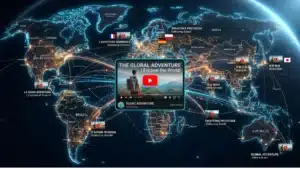
At first glance, video translation seems straightforward. Extract the dialogue, convert it into another language and publish the new version. Easy, isn’t it?
In reality, videos combine multiple communication layers that need to work together seamlessly.
A YouTube video typically includes:
When one of these elements falls out of alignment, the viewing experience suffers.
Imagine a product demonstration where the narration finishes several seconds before the visual explanation appears. Or a training video where technical terminology changes across different sections. Even if the language is technically correct – the content can quickly become confusing.
This is one reason businesses increasingly rely on AI video translation workflows that preserve context rather than simply processing dialogue line by line.
Video localisation introduces several unique challenges that are often overlooked during planning. Let’s understand them in detail:
Viewers notice timing problems almost immediately.
When speech is adapted into another language, sentence length often changes. Some languages require more words to communicate the same message – while others are naturally more concise.
Without proper synchronisation:
A technically accurate translation does not always create an effective viewing experience.
Marketing videos, educational content and product demonstrations – all rely on tone, intent and audience understanding. When context is lost, the message may become less persuasive or harder to follow.
This is where many traditional localisation workflows struggle.
Different audiences interpret messaging differently.
A joke, example, or cultural reference that works perfectly in one market may feel confusing or irrelevant elsewhere. Successful multilingual content often requires contextual adaptation – rather than direct language conversion.
Traditional video localisation can involve multiple teams.
Content creators often need to manage:
As the number of target languages grows, these workflows quickly become difficult to scale.
Not all localisation approaches deliver the same results.
The differences become especially visible when organisations need to translate content regularly across multiple markets.
| Approach | Advantages | Limitations |
|---|---|---|
| Manual Translation | High control | Slow, expensive, difficult to scale |
| Subtitle-Only Tools | Fast deployment | Limited engagement, no voice adaptation |
| Basic AI Translation | Faster than manual workflows | Often lacks context and consistency |
| AI Agent-Based Workflows | Context-aware, scalable, multilingual | Requires specialised platforms |
Most organisations begin with manual translation because it offers the highest level of control. But as content volumes grow, the time, cost and coordination involved make it difficult to sustain across multiple languages.
Many businesses then move to subtitles because they are easier to implement. And subtitles clearly add value. Research found that 80% of consumers are more likely to watch an entire video when captions are available. This highlights how accessibility directly improves video engagement and completion rates.(Source: Forbes)
However, subtitles alone may not deliver the best viewing experience – they cannot adapt voice, tone, or timing for viewers in other languages.
This is one reason organisations increasingly translate YouTube videos with AI using workflows that support both language adaptation and overall viewer experience.
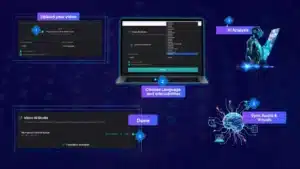
If you are wondering how to translate YouTube videos automatically – the process is now far more streamlined than it was just a few years ago.
The workflow starts by importing the original video.
A strong localisation platform should support:
The goal is to eliminate manual extraction wherever possible.
Rather than creating separate workflows for every language, modern systems allow multiple outputs simultaneously.
For example:
This significantly reduces localisation effort. You can also choose to add subtitles and have transcripts downloaded.
This is where advanced systems differ from traditional tools.
Instead of translating sentences individually, modern AI video translation platforms analyse:
This improves accuracy across the entire video.
One of the most important stages is maintaining alignment between speech and visuals.
Effective workflows ensure:
The final output should be ready for publishing with minimal intervention.
Teams can then review:
before distributing the content globally.
Before localising a video into multiple languages, finalise the original version first. Frequent edits after localisation often create unnecessary rework across every language version.
The value of multilingual video extends across several business functions.
Marketing campaigns often need to communicate consistently across different regions.
Instead of producing separate videos from scratch, businesses can use AI video translation workflows to adapt existing assets – all this while preserving brand messaging.
Product videos rely heavily on clarity and accuracy.
When terminology changes or explanations become inconsistent, customer understanding suffers. Context-aware localisation helps maintain consistency across markets.
Online learning has become increasingly global.
According to Statista, the global e-learning market continues to grow rapidly, with learners consuming content from multiple countries and languages. (Source: Statista)
This makes multilingual educational content a significant opportunity.
Large organisations often need training materials available across regions.
AI-powered localisation helps maintain consistency. This is done while reducing the effort required to create multiple language versions manually.
The market now offers numerous solutions for video localisation. However, many platforms still struggle with the complexities of video communication.
One major issue is literal translation behaviour.
Many systems generate outputs that are grammatically correct but fail to preserve:
Another common challenge is synchronisation.
Poorly aligned subtitles and voiceovers create a fragmented viewing experience. This further reduces engagement.
Scalability is also a frequent limitation. Some tools perform adequately for a single video but become difficult to manage when organisations need to localise hundreds of assets – which is done across multiple languages.
This is why businesses increasingly look beyond the best AI tools for video translation and focus instead on solutions that combine contextual understanding with operational scalability.
But if all of this sounds like a lot of moving parts, that is exactly where the right platform makes the difference.
emotii Video AI Studio is designed specifically for multilingual video workflows where communication quality matters as much as language accuracy.
Instead of processing dialogue in isolation, the platform analyses the broader context of the video to preserve meaning, intent and audience relevance throughout the localisation process.
Businesses can translate YouTube videos with AI while maintaining:
The platform is particularly valuable for:
For organisations exploring multilingual communication at scale – emotii Video AI Studio works alongside broader AI-driven localisation workflows designed for modern global businesses.
Even the most advanced AI systems benefit from a thoughtful localisation process.
Every language version should still feel like your brand. Consistent terminology, messaging and communication style help build trust across markets.
Executive messages, product launches and customer-facing campaigns – all of them deserve an additional review layer before publication.
Sometimes examples, references, or calls-to-action need adaptation as well. Effective localisation focuses on audience relevance – not just language conversion.
Consider subtitle preferences, viewing behaviour and regional content expectations when publishing multilingual videos.
Product names, technical concepts and brand-specific language should remain aligned across all video versions.
Let’s face it – video content has become one of the most powerful ways to reach audiences globally today. The challenge is ensuring that language does not limit that reach.
Traditional localisation workflows often struggle with scale, consistency and turnaround times. Basic tools may improve speed, but they still fall short when it comes to preserving context, tone and viewer experience.
This is why more businesses now translate YouTube videos with AI instead of relying entirely on manual processes.
Modern AI video translation workflows combine contextual understanding, synchronisation and multilingual scalability into a single process. The result is content that feels natural, engaging and relevant across markets.
Platforms like emotii Video AI Studio help organisations move beyond basic language conversion and towards truly multilingual video communication. Because when every viewer can experience your message the way it was originally intended, global growth becomes much easier to achieve.