
Many businesses assume that building a multilingual website is simply a matter of adding another language.
In reality, that is often where the challenges begin.
Visitors may understand the words on a page but still hesitate to engage or convert. The reason is simple: people do not respond to language alone. They respond to familiarity and trust.
As businesses expand globally, localisation is becoming a direct growth driver rather than a content task. While English remains the dominant language across websites – only around 25% of internet users primarily speak English. (Source: EasyAppsEcom). This gap creates a major opportunity for businesses that invest in multilingual experiences.
A website may attract visitors from different regions – but engagement, trust and conversions often depend on how familiar the experience feels once users arrive. This is exactly why WordPress localisation has become a critical part of international growth strategies today.
In this guide, we will explore what localisation really means. We will also understand how it differs from translation and the mistakes businesses commonly make. Lastly, we will review the practical steps required to build a successful multilingual WordPress site – that performs across global markets.
But first, what is WordPress localisation exactly?
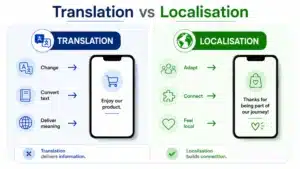
WordPress localisation is the process of adapting a website for different languages and audiences. This is done while preserving the overall user experience and business intent.
Many businesses still treat localisation as a straightforward translation task. However, simply converting text rarely delivers the experience global audiences expect.
A properly localised website considers:
Without these elements, websites may technically support multiple languages while still feeling unfamiliar or disconnected to visitors.
Imagine a UK-based financial services company promoting a service as “simple and straightforward.”
The wording may be translated perfectly into another language. However, the phrase may not carry the same level of credibility or persuasion in another market.
Similarly, a website may correctly convert content and pricing while still feeling out of place overall. This could be because local expectations have not been considered.
Localisation bridges that gap.
It adapts not just the language, but the entire experience.
The internet has made global audiences accessible to businesses of every size – but global reach does not automatically create global engagement.
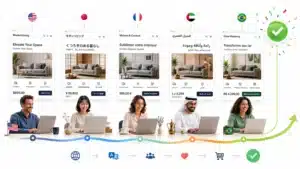
Research found that 65% of consumers prefer content in their own language. This is true even when the quality of that content is imperfect. (Source: CSA Research). This highlights an important reality: users often value familiarity and accessibility as much as linguistic perfection.
For WordPress websites, effective localisation can contribute to:
In short, localisation helps businesses create experiences that feel relevant rather than simply translated.
Many localisation projects tend to underperform. This is not because of technology limitations, but because of poor planning and execution.
Let us look at some of the most common mistakes made by businesses:
Installing a multilingual plugin is not the same as building a localisation strategy.
While plugins can simplify content management – they do not automatically solve challenges related to context, SEO or brand consistency.
Direct language conversion often creates content that is technically accurate – but emotionally disconnected.
Users may understand the message but fail to connect with it.
Many businesses focus on language adaptation – while overlooking technical SEO.
Common mistakes include:
These issues can significantly limit visibility in international search results.
A formal tone on one page and a conversational tone on another can quickly create confusion.
It is best to maintain consistency across all language versions – for trust and credibility.
If you are wondering how to localise a WordPress website effectively, success usually comes down to a few foundational decisions.
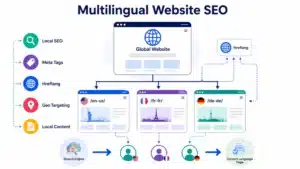
Your multilingual architecture affects both user experience and SEO.
Most businesses choose between:
For many organisations, subdirectories provide the best balance between scalability and search visibility.
Decide your multilingual structure before launching localisation. Restructuring URLs later can create avoidable SEO complications.
Hreflang tags tell search engines which language version should appear for which audience.
Without proper implementation, search engines may serve the wrong language version to users. For example – a visitor searching in French could be directed to an English page even though a French version is available.
This negatively impacts both user experience and search performance.
Many businesses translate page copy but forget about metadata.
Your localisation workflow should also include:
Localised metadata improves search visibility and increases click-through rates among international audiences.
Text is not the only thing users engage with.
Visuals often contain:
A banner that works perfectly in one market may feel irrelevant or confusing in another. Review high-traffic pages and identify visuals that may require regional adaptation.
Internal links help users navigate your website and help search engines understand content relationships.
Every language version should maintain logical links between:
Many businesses localise content but forget to localise their internal linking strategy.
A multilingual experience means little if the website loads slowly.
Research from Google consistently shows that page speed influences both engagement and conversion rates.
For a successful multilingual WordPress site, consider:
Localisation works best when it becomes part of your publishing workflow. Every new page, campaign, or product update should automatically be considered for multilingual rollout.
Several tools can help businesses manage multilingual WordPress content more efficiently.
WPML is one of the most widely used localisation plugins for WordPress.
It allows businesses to manage multilingual content and create language-specific pages. It can also maintain multilingual SEO structures within WordPress.
It is particularly useful for organisations managing multiple language versions of the same website.
Polylang helps businesses create and manage multilingual websites directly within WordPress.
The platform is popular among smaller teams – this is because of its flexibility and relatively lightweight setup.
However, as localisation workflows become more complex – businesses often need additional capabilities around contextual adaptation and consistency management.
While both tools help manage multilingual content – they primarily focus on administration. They do not always solve challenges around contextual understanding, brand voice preservation, or large-scale localisation workflows.
Many localisation projects start successfully but become difficult to sustain as websites grow.
One major challenge is context.
Content is rarely consumed in isolation. Product pages, blogs, landing pages, pricing pages and support resources all contribute to a larger customer journey. When localisation systems process content independently, consistency often breaks down.
Scalability is another common challenge.
As websites expand across regions, teams frequently struggle with:
Manual processes eventually become operational bottlenecks.
SEO also becomes disconnected from localisation efforts. Teams focus heavily on language adaptation while overlooking technical SEO requirements that support multilingual discoverability.
This creates a fragmented experience for both users and search engines.
Before multilingual website management starts feeling like a never-ending process, it helps to remember that localisation does not have to be fragmented.
emotii Website AI Studio is built specifically for organisations managing multilingual digital experiences at scale.
Rather than relying on direct language conversion alone, the platform adapts website content contextually while preserving brand voice, messaging consistency and multilingual SEO readiness.
The platform helps businesses maintain:
It also supports adaptation across 126+ languages, helping businesses create globally relevant experiences without adding significant operational overhead.
For organisations exploring multilingual growth strategies, emotii also offers insights into AI-powered communication workflows. This also includes multilingual customer engagement approaches. These support international expansion more effectively.
Before launching your localisation initiative, use this checklist as a final review.
These remain some of the most effective best practices for multilingual WordPress sites operating across global markets.
As businesses continue expanding internationally, localisation is becoming a growth lever rather than a technical requirement.
A successful multilingual WordPress site does more than display content in different languages. It creates experiences that feel relevant and natural for every audience.
The businesses seeing the strongest international growth are moving beyond basic translation workflows. They are investing in smarter localisation strategies. These combine context, SEO, user experience and scalability.
As AI continues to reshape multilingual communication, context-aware localisation will become increasingly important. This is especially true for businesses looking to reach global audiences effectively.
This is where solutions like emotii Website AI Studio can make a meaningful difference. By combining AI-powered localisation with contextual understanding, brand voice preservation, multilingual SEO support and scalability across 126+ languages, emotii helps businesses create website experiences that feel locally relevant – all this without adding operational complexity.
If your website is already attracting visitors from multiple regions, now may be the right time to evaluate whether your content is simply translated – or truly localised.