
Google Translate has become the default translation tool for millions of people worldwide.
Need to understand a menu while travelling? Translate a quick email? Decode a webpage in another language? Most people instinctively open Google Translate.
But business communication is a very different challenge.
A website, product page, customer support portal, or marketing campaign – carries far more responsibility than a casual conversation. Every translation influences how customers perceive your brand and understand your products – ultimately deciding whether to trust you.
As global audiences become increasingly accessible – businesses are asking a more important question than ever before: Is Google Translate reliable enough for professional multilingual communication?
The answer is not entirely straightforward.
Google Translate is incredibly useful in many situations -improving dramatically over the years. However, when organisations begin managing multilingual websites, global customer journeys and international brand experiences – reliability means much more than converting words from one language into another.
In this guide, we will explore Google Translate accuracy and where it struggles. Additionally, we will see why many organisations are moving towards more advanced AI website translation solutions – especially for multilingual growth.
Google Translate is a machine translation platform developed by Google. It supports hundreds of languages across text, documents, images, websites and voice interactions.
At a high level – it uses neural machine translation technology to predict how text should be translated between languages. Instead of translating individual words one by one – modern systems analyse entire phrases and sentence structures to produce more natural outputs.
Its popularity is enormous.
Google has publicly reported that billions of translations are processed through the platform every day – making it one of the most widely used language tools in the world.
The platform is particularly attractive because it is:
For personal communication, these advantages make it incredibly valuable.
For businesses, however, the question shifts from convenience to reliability.
In many everyday situations, yes.
For casual communication, general understanding and quick interpretation – Google Translate is often reliable enough to help users understand the meaning behind content.
If someone needs to:
Google Translate usually performs reasonably well.
The challenge emerges when reliability is measured against business outcomes.
A reliable business translation must preserve:
This is where Google Translate reliability becomes less predictable.
Consider the phrase:
“We help businesses scale with confidence.”
A literal translation may correctly convert the words into another language.
However, the emotional message behind “scale with confidence” may not resonate similarly across markets.
In one region, the translation may sound professional.
In another, it may sound overly promotional.
In a third, it may lose the original meaning entirely.
The words may be translated correctly, while the business message becomes weaker.
This distinction is critical when evaluating Google Translate reliability for websites and customer-facing communication.
Certain sectors depend heavily on terminology precision.
Examples include:
In these industries, even small translation inconsistencies can create confusion.
Google Translate often understands general language extremely well. However, specialised terminology frequently requires deeper contextual understanding than general-purpose translation systems can provide.
This is one of the most commonly searched questions online.
The reality is that Google Translate accuracy varies significantly depending on the language pair being translated.
Research evaluating Google Translate found accuracy levels ranging from roughly 82.5% to 94% for several widely spoken European languages. However, performance declined considerably for lower-resource languages and more specialised content – demonstrating that translation quality depends heavily on context and language pair. (Source: NIH)
Languages with large amounts of training data available online often produce stronger results.
Less common language pairs may produce more noticeable inaccuracies.
One of the biggest misconceptions about translation quality is assuming that grammatical accuracy equals communication accuracy.
These are very different things.
A translation can be:
And still fail to communicate the intended message.
For example, marketing copy often relies on:
These elements are difficult for traditional machine translation systems to preserve consistently.
This explains why discussions around Google Translate accuracy increasingly focus on context rather than vocabulary alone.
Translation mistakes do not always create obvious errors.
Often, they create subtle friction.
Visitors may not consciously identify the issue, but they may feel:
Over time, these small losses compound into measurable business impact.
To provide a balanced perspective – it is important to acknowledge that Google Translate remains extremely useful in many situations.
For travel-related scenarios, it is often highly effective.
Users can quickly translate:
The goal here is understanding rather than perfect localisation.
Many organisations use Google Translate to gain quick visibility into foreign-language content.
Examples include:
In these cases, obtaining the general meaning is usually sufficient.
Google Translate can also serve as a useful starting point for translation workflows.
Teams often use it to generate an initial draft before applying professional review and localisation processes.
For these purposes, Google Translate reliability is often more than adequate.
The challenges become more visible when content directly influences customer experience.
Websites are among the most complex translation environments.
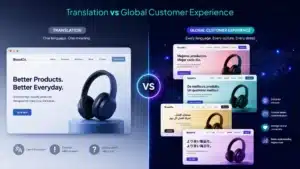
A multilingual website requires more than translated text.
It must preserve:
Google Translate was not designed to manage complete website localisation strategies.
Localisation influences more than readability. Google’s international growth research consistently highlights that users are more likely to engage with websites that feel locally relevant, from language and imagery to navigation and messaging structure. (Source)
Search engines do not rank websites based solely on translated content.
Multilingual SEO requires:
These requirements extend far beyond translation.
This is why businesses increasingly invest in specialised AI website translation platforms rather than relying solely on browser-based translation tools.
A company’s website is often its most important sales asset.
Literal translations frequently struggle with:
A phrase that performs well in English may require adaptation rather than direct translation to achieve the same impact elsewhere.
Support interactions depend heavily on empathy and clarity.
A technically correct response can still feel robotic if tone and intent are lost during translation.
For global businesses, this directly affects customer satisfaction.
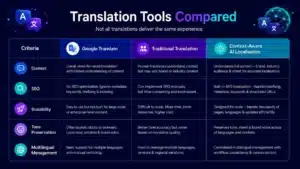
The multilingual landscape has evolved significantly over the past decade.
Human translation offers strong contextual understanding.
Advantages include:
Challenges include:
Basic AI translation improves speed dramatically.
Benefits include:
However, context often remains limited.
Modern AI agent workflows represent a newer approach.
Instead of translating isolated text fragments, these systems analyse broader communication contexts.
They can consider:
This is increasingly becoming the preferred approach for businesses managing multilingual websites at scale.
At this point, the question is no longer whether translation is possible.
The real question is whether multilingual experiences can remain consistent, scalable and contextually accurate – as businesses grow globally.
This is where emotii Website AI Studio takes a different approach.
Rather than focusing on direct language conversion, the platform adapts website content contextually while preserving brand intent, terminology and user experience.
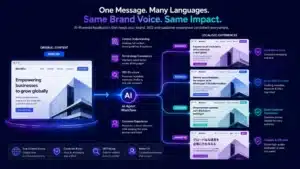
The platform detects and processes:
This ensures that important website elements are not overlooked during localisation.
Instead of translating content sentence by sentence, emotii evaluates the broader context of each page.
This helps preserve:
across languages.
One common frustration with traditional translation systems is the accidental modification of:
emotii preserves these elements exactly as intended.
The platform supports multilingual website translation while maintaining search visibility.
Features include:
Businesses can make websites multilingual through a plug-and-play implementation process – without rebuilding existing website infrastructure.
The platform currently supports 126+ languages, helping organisations scale multilingual experiences across markets while maintaining consistency.
For businesses exploring the future of multilingual communication, solutions like emotii demonstrate how AI website translation is evolving beyond simple translation and towards full localisation workflows.
Whether you use Google Translate, human translators, or advanced AI translation software – several best practices consistently improve outcomes.
Translation should not change how your organisation sounds.
Maintain consistency across:
Even advanced systems benefit from strategic review.
Focus reviews on:
Localisation should include:
Multilingual websites require:
Before publishing multilingual content:
These practices help businesses achieve stronger multilingual website translation outcomes regardless of the tools they use.
Yes. For casual conversations, travel scenarios and understanding general content – Google Translate is typically reliable enough for most users.
It can provide a general understanding of website content – but it often lacks the contextual adaptation, SEO support and brand consistency required for professional multilingual websites.
For basic understanding, yes. For customer-facing website localisation, businesses usually require more advanced systems that account for context, user experience and multilingual SEO.
The best solution depends on the use case. Businesses managing multilingual websites often look for specialised platforms that combine translation, localisation, SEO support and brand consistency – rather than relying solely on general-purpose translation tools.
Context helps ensure that translations preserve meaning, intent and tone rather than simply converting words between languages. This becomes especially important for websites, marketing content and customer communication.
So, is Google Translate reliable?
For everyday communication, quick understanding and casual multilingual interactions, absolutely.
It remains one of the most useful translation tools available today.
However, reliability changes when business outcomes are involved.
Websites, customer journeys, brand messaging, SEO performance and multilingual growth require much more than literal translation. They require contextual understanding, localisation, consistency and scalability.
This is why many organisations are moving beyond traditional translation tools and adopting more advanced multilingual systems.
Platforms like emotii Website AI Studio help businesses create multilingual experiences that preserve intent, maintain brand voice, support SEO and scale across 126+ languages without introducing operational complexity.
As global audiences become increasingly important, the future of multilingual communication will belong to organisations that focus not only on translating content, but on creating experiences that feel local everywhere.