
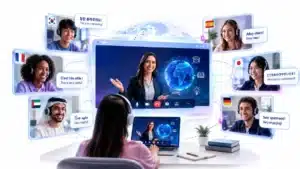
Education is no longer confined to a classroom, campus or even a country.
A university can teach students across continents. A company can train teams in multiple markets at the same time. An international organisation can bring experts, educators & communities together. This is done without requiring everyone to be in the same room.
Digital learning has made this possible.
But one barrier remains that technology has not completely solved: language.
A virtual classroom may connect hundreds of learners. But if students cannot fully understand the language being used, access does not automatically become inclusion. UNESCO reports that 40% of people globally lack access to education in a language they speak & understand fluently. This affects more than a quarter of a billion learners. (Source: UNESCO)
This is why the next evolution of online education is not simply about making learning digital. It is about making learning understandable, accessible & participatory – across all languages.
Multilingual education platforms are emerging as an important part of that shift. By combining virtual classrooms, live communication, AI-powered captions & real-time language technologies, they can all help institutions & organisations reach learners. These are the ones who previously faced significant language barriers.
The result is a more connected model of education. This is where geographical and linguistic boundaries become less restrictive.
A multilingual education platform is a digital learning environment designed to support teaching, collaboration & participation across multiple languages.
At its simplest, it can provide access to learning materials in different languages. More advanced platforms can support real-time multilingual communication. This allows participants to listen, speak, read & interact in their preferred language during a live session.
This can bring together several capabilities, including:
The important distinction is that multilingual learning is not simply about making educational content available in another language.
It is about making the learning experience itself accessible.
Consider an international university running a virtual seminar with students from India, Japan, France & Brazil. A single English-language lecture may technically be available to everyone. But the experience will not be equal if some learners need to process every sentence through a second or third language.
A multilingual learning environment can reduce that friction. This is done by allowing learners to engage with the same lesson through language technologies that work alongside the original teaching experience.
That makes the classroom more connected – without requiring every participant to have the same linguistic background.
Language affects far more than whether a learner can understand a sentence.
It influences participation, confidence, comprehension & the ability to engage with other people.
The World Bank has found that language-of-instruction policies affect learning, access, equity and inclusion. Its research has also highlighted that nearly 37% of students in low- and middle-income countries are taught in a language they do not understand.
For digital education providers, this makes multilingual accessibility more than a convenience. It becomes an important part of creating an effective learning environment.
Learners should not have to choose between accessing education & understanding it comfortably.
Multilingual platforms can help institutions extend learning opportunities to students who speak different languages – including international students, multilingual communities & geographically distributed teams.
This is particularly valuable for universities, NGOs & organisations – delivering education across regions.
A classroom becomes more inclusive when participants can contribute without language becoming a constant source of friction.
Real-time captions, translated communication and multilingual interaction – all can help learners follow discussions & participate more confidently.
This does not replace the value of learning a common language. Instead, it reduces unnecessary barriers – while people learn, collaborate & exchange ideas.
Understanding is closely connected to participation.
When learners can follow a discussion more comfortably, they are more likely to ask questions, contribute to conversations & interact with other participants.
For online learning providers, that can make the difference between simply delivering content. It can also create an environment where people actively learn.
Language can also limit the market an educational institution can serve.
A university, training provider or course creator – all of them may have expertise that is relevant to learners worldwide. But delivering that expertise in only one language can restrict its reach.
Multilingual technology makes it easier to extend programmes to new audiences – without creating entirely separate learning ecosystems for every market.
Modern education increasingly involves collaboration between institutions and countries.
Students work on international projects. Researchers collaborate across borders. Universities organise global seminars. Businesses train employees across multiple regions.
Multilingual communication makes these interactions more accessible. It can help participants contribute without language differences dominating the conversation.
Education is fundamentally about sharing knowledge.
When language prevents that knowledge from travelling, valuable ideas can remain confined to particular regions or communities.
Multilingual learning platforms can help knowledge move between languages, institutions and audiences more efficiently.
UNESCO’s recent guidance on multilingual education similarly emphasises the importance of education in languages learners understand – linking multilingual approaches with inclusion & better learning outcomes.
Going global with education sounds straightforward until the classroom itself becomes multilingual.
A virtual learning environment needs to account for more than simply providing translated content.
The most obvious challenge is also one of the most consequential.
If a learner understands only part of a lecture, misses important terminology or struggles to follow rapid discussion, the quality of the learning experience can decline. This can happen even when the underlying educational content is excellent.
Education often depends on nuance.
A lecturer may explain a complex concept using an example, analogy or culturally specific reference. A direct translation may preserve the words. This is done while losing some of the intended meaning.
This becomes particularly important in technical subjects, professional training & interactive discussions.
Learners who are less confident communicating in the teaching language may hesitate to ask questions or participate in group discussions.
Over time, this can create a classroom where some voices are consistently heard while others remain quieter.
For educators, supporting several languages manually can become operationally difficult.
Providing separate interpreters, parallel sessions, or multiple versions of every resource increases complexity and cost.
The challenge is finding a way to provide multilingual access without creating an entirely separate workflow for every language.
Language is only one part of accessibility.
Learners may also require captions, transcripts or other forms of support. This is needed to engage effectively with online sessions.
A modern learning platform therefore needs to consider accessibility as part of the overall experience rather than as an optional feature.
Global education introduces another practical problem – everyone may not be awake at the same time.
A live session scheduled for London could take place late at night for learners in Asia or early in the morning for participants in North America.
Recordings, transcripts & asynchronous resources – all can help extend the value of live learning beyond a single time zone.
Not every platform needs every feature. The right combination depends on the organisation, audience and learning model.
However, several capabilities are becoming increasingly important.
Live teaching remains central to many learning experiences.
A strong platform should allow educators, trainers & presenters to communicate with learners in real time. This is done while supporting multilingual participation.
Live captions make sessions easier to follow. This is particularly helpful when participants are dealing with unfamiliar terminology or different accents.
They can also provide an additional accessibility layer for learners who prefer reading alongside listening.
For international audiences, real-time language interpretation can reduce the friction created by different languages.
Rather than forcing every participant to communicate in one language, the platform can help learners access the same conversation. This is done through their preferred language.
Learning should not be reduced to watching a speaker talk.
Presentations, screen sharing & visual demonstrations – all help educators explain complex ideas while maintaining audience attention.
Interaction is particularly important in virtual learning.
Polls can quickly check understanding or gather opinions. Q&A allows learners to raise questions during a session.
For multilingual audiences, these interactions should ideally work across languages as well.
Recordings allow learners to revisit lessons, catch up after missing a session or learn asynchronously. This is achieved across different time zones.
When paired with transcripts or captions, recorded content becomes even more useful.
Small-group discussions can make virtual classrooms more collaborative.
Breakout rooms are particularly useful for workshops, language learning, team exercises and professional training.
Learners may join from laptops, tablets or mobile devices.
A multilingual learning platform should therefore provide a consistent experience across common devices. This is to be done rather than assuming every participant has access to the same hardware.
Educational platforms often handle sensitive information. This is done including participant data, institutional information & private training content.
Security, access controls and responsible data handling – all of them need to be considered alongside functionality.
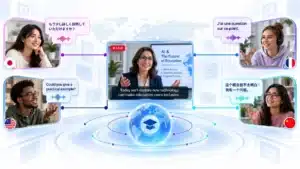
Artificial intelligence is changing multilingual education. It can handle several language-related tasks within the same learning workflow.
Instead of treating translation, transcription, accessibility and communication as completely separate processes, AI can connect them.
A live lesson can be converted into text while it is happening.
This creates a searchable record of the session & gives learners another way to revisit important information.
AI-powered language technologies can interpret or translate spoken communication in real time, allowing learners to follow sessions without relying entirely on their knowledge of the speaker’s language.
This is particularly useful for international conferences, academic seminars, global training and virtual classrooms.
Long lectures and training sessions can generate a significant amount of information.
AI can help turn conversations into structured summaries and notes, making it easier for learners to review what was discussed after a session.
AI can support captions, transcripts and multilingual communication at scale.
This means accessibility features that once required significant manual effort can increasingly become part of the standard digital learning experience.
AI can also help educational platforms adapt information to individual learners.
Over time, this could mean learners receive explanations, summaries or supporting resources that better match their language preferences and learning needs.
The technology is still evolving, but the direction is clear: AI is moving multilingual education from a model of content translation towards contextual learning support.
UNESCO’s 2025 guidance on digital learning similarly identifies AI and digital competencies as increasingly important to inclusive and future-ready education systems.
There is an important distinction between translating educational content and creating a multilingual learning experience.
Translation changes the language.
Multilingual learning changes how people access and participate in education.
For example, translating a recorded lecture into Spanish might make the content understandable to a Spanish-speaking learner.
A multilingual learning platform can go further.
The learner might:
The difference is subtle but important.
The goal is not to create several disconnected versions of the same classroom. It is to create one shared learning environment that can accommodate multiple languages.
That model is particularly powerful for global universities, corporate learning teams, international organisations and training providers.
The applications extend well beyond traditional classrooms.
Universities increasingly work with international students, visiting academics and research partners across countries.
Multilingual virtual seminars and academic conferences can help make these interactions more inclusive.
Global companies often need to deliver the same training programme to employees across several markets.
Rather than running separate sessions for every language group, multilingual virtual training can help organisations deliver common learning experiences while supporting local language preferences.
Course creators can reach new audiences without rebuilding their entire educational operation for every market.
Multilingual delivery can extend the useful life and potential audience of existing expertise.
International organisations often work across communities with different languages and cultural contexts.
Multilingual digital learning can make training, workshops and knowledge-sharing programmes easier to deliver across borders.
Training companies can expand their programmes to international audiences while maintaining a centralised delivery model.
This is particularly useful for professional development, compliance training, technical education and skills programmes.
Webinars, seminars and conferences bring together audiences who may speak several different languages.
Real-time multilingual communication can make these events more accessible without requiring every attendee to speak the language of the presenter.
For organisations delivering live education, training or events across languages, the challenge is not simply hosting a video call.
It is creating an environment where participants can listen, understand and participate.
emotii Conference is designed around this idea.
The platform supports multilingual communication across conferences, webinars, virtual networking sessions and educational events, with real-time language capabilities across 70+ languages.
Participants can experience translated conference audio while retaining the flow of the original presentation. The platform also supports multilingual live chat, allowing attendees to interact during sessions rather than simply listen.
For educators and event organisers, this creates a more interactive learning environment.
Features include:
Participants can switch between supported languages during a live conference without restarting the session, while attendees can join through a conference link without needing to download additional software.
This makes the platform suitable for different types of global learning experiences.
Universities, schools and training providers can use multilingual communication to make live lessons more accessible to international learners.
L&D teams can deliver training sessions to employees across regions without creating completely separate communication workflows.
Organisations can host multilingual webinars where participants can follow presentations and interact through chat and polls.
Researchers, educators and students can participate in multilingual seminars and discussions, helping ideas move more freely across language boundaries.
Educational institutions and organisations can host larger multilingual events while giving attendees greater control over how they experience the session.
The broader opportunity is not simply to make conferences multilingual.
It is to make global learning feel like one connected experience.
Technology alone does not guarantee better learning.
Organisations should also consider how multilingual capabilities fit into their broader educational strategy.
Identify the languages your audience actually uses and understands.
Do not assume that translating everything into the largest number of languages automatically creates a better experience.
Not every piece of content requires the same level of adaptation.
Live instruction, assessments, safety information and complex technical material may need greater attention than supplementary resources.
Educational programmes often contain specialised vocabulary.
A consistent terminology framework can help learners avoid confusion when the same concepts appear across lectures, presentations, transcripts and supporting materials.
AI can dramatically improve the speed and scalability of multilingual communication, but educators and subject-matter experts still play an important role.
Human review is especially valuable for complex subjects, culturally sensitive content and high-stakes learning environments.
Expanding into new languages is not successful simply because more people can access a session.
Organisations should also look at:
The objective is better learning, not simply more translated content.
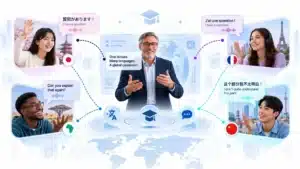
The future of global education will not necessarily mean creating a separate classroom for every language.
Instead, technology is moving towards learning environments where multiple languages can coexist within the same experience.
A lecturer can teach once.
Students can listen in different languages.
Questions can be asked across languages.
A global training session can include participants from several countries.
And the resulting conversation can remain connected rather than fragmented into separate language groups.
This matters because linguistic diversity is not disappearing. In fact, migration, international education and digital collaboration are making multilingual interaction increasingly common.
UNESCO notes that more than 7,000 languages are spoken or signed around the world, while only a fraction are currently represented as languages of instruction. (Source: UNESCO study)
AI and language technology cannot solve every challenge in education. But they can help reduce one of the most persistent barriers to participation: the assumption that everyone must learn, teach and collaborate through the same language.
That is the real promise of multilingual learning platforms.
They are not simply making education available in more languages.
They are helping make global education more accessible, collaborative and connected.
A multilingual education platform is a digital learning environment that supports teaching and participation across multiple languages. Depending on the platform, this can include live classes, virtual classrooms, captions, real-time language interpretation, multilingual chat, recordings and interactive learning features.
Multilingual education can improve accessibility and inclusion by allowing learners to engage with educational content and communication in languages they understand more comfortably.
AI can support real-time captions, transcription, language interpretation, translation, meeting summaries and other accessibility features. This allows organisations to support multilingual audiences without managing every language-related task manually.
Yes. Modern platforms can combine live video conferencing with multilingual audio, captions, chat, polls, Q&A and other interactive features to support virtual classrooms, webinars and training sessions.
Yes. Global businesses can use multilingual platforms to deliver training, onboarding, workshops and knowledge-sharing sessions to employees across different countries and language groups.
emotii Conference supports multilingual communication across live conferences, webinars, virtual and hybrid events. It offers real-time translated audio across 70+ languages, multilingual chat, live polls, language switching and audience participation features, with conferences supporting up to 1,000 participants.
Global education has already crossed geographical boundaries.
The next challenge is crossing linguistic ones.
As universities, businesses, training providers and international organisations reach increasingly diverse audiences, multilingual communication is becoming an important part of delivering accessible and engaging learning experiences.
The strongest multilingual education platforms will not simply translate course material. They will help people participate, collaborate and learn together, regardless of the language they speak.
AI is making that vision increasingly practical through real-time captions, language interpretation, transcription, multilingual interaction and intelligent learning support.
And for organisations delivering live learning experiences, platforms such as emotii Conference provide a way to bring these capabilities into one connected environment.
Looking to deliver engaging multilingual training, webinars or virtual classrooms? Discover how emotii Conference helps organisations connect learners across languages with AI-powered communication and collaboration tools.