
AI has changed the conversation around translation.
What once required hours of manual work can now be processed in seconds. Machine translation, large language models, speech recognition & AI-powered language tools are making multilingual content faster & easier to produce than ever.
But speed is not the same as quality.
For professional translators, the question is rarely whether AI should be used. The more useful question is how it should be used.
A good AI translation tool should not ask a linguist to hand over their judgement. It should give them better inputs, reduce repetitive work & make it easier to focus on the parts of translation where human expertise matters most.
That distinction is becoming increasingly important. ISO 18587 already provides requirements for the human post-editing of machine translation output. This is done while a revised standard for post-editing non-human translation output is currently under development. The direction is clear: AI-generated language can be part of a professional workflow. But human expertise remains central to quality.
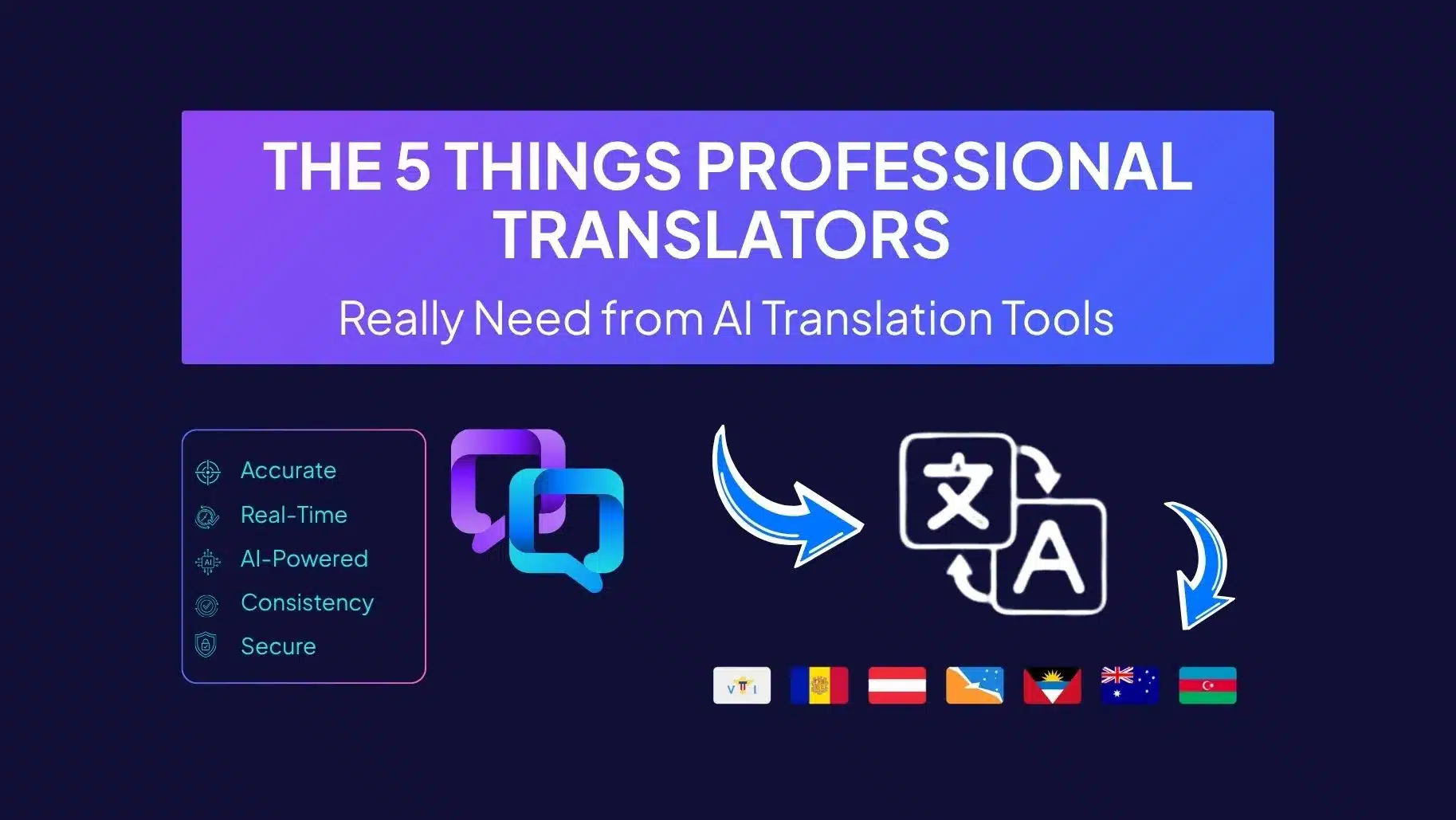
So, what do professional translators actually need from AI?
Not another button that says “translate”.
They need technology that understands the realities of professional language work.

Modern AI translation systems can produce remarkably fluent output. However, fluency does not automatically mean accuracy.
A sentence can be grammatically correct & still be wrong for its audience.
Consider a financial document, a medical training video or a legal contract. The terminology needs to be precise. A marketing campaign needs to preserve its personality. A technical manual needs consistency. A conference interpretation needs to make sense in real time.
Then there is cultural context.
Idioms, humour, politeness, implied meaning & regional expressions – all of them do not always have direct equivalents. A literal rendition can preserve the words while losing the message.
This is where professional translators bring something AI cannot reliably provide on its own: judgement.
They understand why a particular term was chosen, when a phrase needs to be adapted rather than rendered literally & when an apparently acceptable output needs to be rejected altogether.
Research published in 2026 based on interviews with professional translators across 11 languages & 11 domains found something interesting. It showed that translators remain cautious about AI systems when human verification & other essential aspects of translation work are compromised. The study argues for translation technology that serves translators rather than replaces them.
The best AI translation workflow, therefore, is not human versus machine.
It is human expertise supported by machine efficiency.
Professional translators need AI that understands more than individual sentences.
Context changes meaning.
A word used in a software interface may mean something completely different in a medical report. A formal corporate announcement requires a different register from a social media post. Even within the same document, terminology can change depending on who is speaking & what they are trying to achieve.
That means professional AI translation tools should consider:
This is particularly important when working with long-form content. Translating each sentence independently can create inconsistencies. These only become visible when the finished document is reviewed as a whole.
For translators, context awareness means less time correcting avoidable mistakes & more time making meaningful linguistic decisions.
It also changes what “accuracy” means.
Accuracy is not simply matching words between two languages. It is preserving meaning, intent & relevance in the target language.
That is why human review remains important even when AI output sounds natural. A professional linguist can identify subtle errors that a general quality check may overlook.
Translation does not always happen inside a document.
Professional translators and interpreters increasingly work across meetings, webinars, training sessions, conferences & international projects. In these environments, waiting for content to be translated afterwards may not be practical.
Real-time language technology can help participants communicate across language barriers. This is done while the conversation is happening. Speech recognition can capture spoken language, AI can interpret it & participants can receive the output – all this is done in a language they understand.
For interpreters, this does not necessarily mean removing the human from the conversation. Instead, AI can support situations where several languages, participants or communication channels need to be managed simultaneously.
For example, a multilingual business meeting might involve participants speaking different languages. It may also have written chat happening alongside the discussion and documents being shared on screen. A language professional may be responsible for ensuring that important information is communicated accurately. This is done while AI handles supporting tasks. It may include transcription or multilingual chat.
This is where tools such as emotii Meetings can fit into a broader multilingual workflow. The platform combines real-time speech interpretation with multilingual chat, transcription, recording & AI-generated meeting summaries.
The important point is not that AI eliminates the need for language professionals. It can make multilingual communication easier to manage.
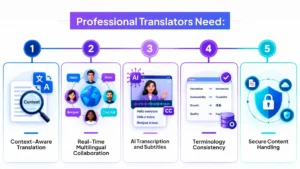
Transcription is one of the most repetitive parts of many language workflows.
A translator working with a webinar, interview, lecture or video may first need to create a transcript before they can begin adapting the content. Subtitles then need to be timed, reviewed & exported.
AI can take much of that groundwork off the translator’s desk.
Speech-to-text systems can generate transcripts quickly. Those transcripts can then become the foundation for translation, subtitling, accessibility or content repurposing.
This is particularly useful when working with large volumes of audiovisual content.
Instead of manually transcribing an hour-long recording before starting the actual language work, a translator can begin with an AI-generated transcript. This is how they can focus their time on checking terminology, correcting recognition errors & adapting the final content.
The same principle applies to subtitles.
AI can generate a first version. A professional linguist then checks whether the text accurately reflects the speaker, fits the available space and timing & reads naturally.
For organisations producing multilingual video at scale, emotii Video AI Studio combines speech-to-text and text-to-speech processing with subtitles. It also has transcripts and multilingual video adaptation across 70+ voice languages.
The value is not simply automation.
It is removing repetitive preparation work so linguistic expertise can be applied where it has the greatest impact.
Ask any professional translator about difficult projects & terminology will likely come up.
Consistency matters.
A company may have a preferred product name, a specific technical term or an approved way of describing a service. A pharmaceutical organisation may have tightly controlled terminology. A legal team may require specific wording to remain consistent across documents.
AI translation without terminology controls can introduce variation where none should exist.
Professional translators therefore need tools that allow language knowledge to become reusable knowledge.
This can include:
The broader idea is simple: every translation project should make the next one better.
Translation memory has long supported this principle in professional translation workflows. AI does not make that requirement disappear. In fact, as organisations produce more multilingual content, consistency becomes even more important.
A strong AI workflow should allow professional linguists to influence the system. This is to be done rather than simply accept whatever output it produces.
The translator’s correction should be useful beyond one sentence. It should help establish a repeatable language standard for the organisation.
There is another requirement that is easy to overlook when comparing AI translation tools: security.
Professional translators often work with confidential information. This could include product launches, financial documents, legal material, internal communications, research, customer data or unreleased marketing campaigns.
Sending that content to an AI system is therefore not just a quality decision. It is a data-management decision.
A 2026 study examining privacy, confidentiality & information security among 439 professional translators found something unique. It indicated that translators increasingly face privacy risks as they work within AI-powered cloud environments. The study highlights the importance of how client data & translation resources are managed.
Before adopting an AI translation tool, professionals & organisations should consider questions such as:
For professional language work, security should not be an afterthought.
A tool that saves ten minutes but introduces unnecessary confidentiality risks is not necessarily improving the workflow.
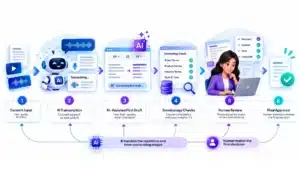
The most useful way to think about AI translation is as a productivity layer.
It can handle the mechanical work.
The translator handles the judgement.
That division can make professional workflows considerably more efficient.
AI can help with:
First drafts: Generate an initial rendition that gives the linguist a starting point.
Repetitive content: Process recurring phrases, standard communications and high-volume material.
Transcription: Turn speech into searchable text before translation or review.
Subtitles: Create initial subtitle files that can then be checked & refined.
Real-time communication: Support multilingual meetings, conferences and discussions.
Quality support: Identify possible inconsistencies or terminology issues for human review.
Collaboration: Help translators, reviewers, clients and multilingual teams work from the same language resources.
This is essentially a human-in-the-loop model.
The AI does not have to make every decision. Instead, it performs tasks at machine speed while the professional remains responsible for linguistic quality and final judgement.
That model is already reflected in industry standards. ISO 18587 specifically addresses full human post-editing of machine translation output & the competencies required of post-editors.
The question, then, is not whether translators will use AI.
It is whether the tools they use are designed around how translators actually work.
There is also a broader shift happening.
AI language technology is moving beyond the traditional translation box.
Instead of simply converting a finished document from one language to another, AI can now support multilingual communication while it happens.
A translator may work on a document. An interpreter may support a live conversation. A localisation specialist may adapt a video. A global team may need to collaborate across several languages simultaneously.
These are different problems, even though they all involve language.
This is why platforms such as emotii Meetings and emotii Conference are relevant to the wider evolution of AI-powered language technology.
emotii Meetings supports real-time speech interpretation across 70+ languages, alongside transcription, recording, AI summaries and multilingual chat.
emotii Conference extends the same idea to larger multilingual events, supporting interpreted audio, multilingual chat, live polls and participation for up to 1,000 attendees across 70+ languages.
For professional translators & interpreters, these capabilities can become part of a larger communication workflow rather than a replacement for linguistic expertise.
The strongest workflows are not built around letting AI do everything.
They are built around assigning the right task to the right capability.
A practical workflow might look like this:
Identify the audience, purpose, terminology and quality requirements before processing anything.
Use AI for initial translation, transcription, subtitle generation or real-time language processing.
A translator or language specialist reviews the output for meaning, tone, terminology, cultural relevance and accuracy.
Save important terminology and corrections so future content becomes more consistent.
Review the finished content in its actual context, rather than evaluating individual sentences in isolation.
This approach gives AI a meaningful role without giving it responsibility it cannot reliably carry.

The translation industry does not need to choose between human expertise and artificial intelligence.
It needs better ways to combine them.
AI is exceptionally useful at speed, scale, transcription, pattern recognition and repetitive processing. Professional translators bring linguistic judgement, cultural understanding, subject expertise & accountability.
Neither side has to do everything.
The future of professional translation is therefore likely to be less about replacing one with the other and more about building workflows where each does what it does best.
For translators, that means choosing AI tools based on more than language coverage or output speed.
And above all, look for security and meaningful human oversight.
The best AI translation tool is not the one that tries to make the translator unnecessary.
It is the one that makes the translator more effective.
Looking to make multilingual communication easier across meetings, conferences and global teams? Explore emotii’s AI-powered multilingual communication solutions and see how AI can support more connected conversations without losing the human element.
AI is likely to automate parts of translation work, particularly repetitive and high-volume tasks. However, professional translators remain important for context, cultural adaptation, specialised terminology, quality assurance and human judgement. The more useful model is human-AI collaboration rather than replacement.
Professional translators typically need more than basic language conversion. Useful capabilities include context-aware output, terminology management, transcription, multilingual collaboration, quality controls and strong data-security measures.
Yes. AI-generated content can provide a useful starting point that professional translators can review, refine and adapt for accuracy, context, tone and intended meaning.
It depends on the content, language pair, subject matter and quality requirements. AI can produce strong results, but professional review remains important where accuracy, cultural relevance or specialised terminology matters.
AI can support interpreters and multilingual teams through real-time speech recognition, interpretation, transcription, multilingual chat & meeting documentation. These capabilities can reduce repetitive workload and support communication without removing the need for professional judgement.
Businesses should evaluate language coverage, context handling, terminology consistency, integrations, human review options, security, data retention & the types of content being processed. The right tool should fit the organisation’s workflow rather than simply offer the largest number of languages.