
A client in Dubai joins a London-based solicitor for a consultation. A US legal team needs to brief colleagues in France. A cross-border transaction brings together lawyers, advisers and clients speaking five different languages.
The legal work may be complex enough already. Language should not be another bottleneck.
For international law firms, multilingual communication is becoming part of everyday practice. Cross-border transactions, international arbitration, immigration matters, global investigations and multinational corporate work – all of them require people to exchange detailed information across languages and jurisdictions.
At the same time, legal professionals are becoming increasingly comfortable using AI to support their work. The 2026 Wolters Kluwer Future Ready Lawyer Report found that 92% of legal professionals surveyed use at least one AI tool in their daily workflow. It also showed that 62% reported saving between 6% and 20% of their weekly time through AI. (Source: Wolters Kluwer Future Ready Lawyer Report)
That does not mean AI can replace legal judgement or professional translation. It means firms have an opportunity to use AI where it is particularly useful. This primarily includes reducing communication friction, making multilingual collaboration faster & helping legal teams spend more time on the work that requires their expertise.
For law firms serving clients across borders, AI translation is becoming less about convenience. It is now more about building a practical multilingual communication layer around legal work.

Let’s face it: cross-border legal work creates communication demands that go well beyond translating a document from one language into another. Let’s go over some of the core challenges in the domain:
A client should not have to navigate a complex legal discussion in a language they are not comfortable using.
This becomes particularly important during consultations & negotiations. It is also true around sensitive discussions where misunderstanding a question or instruction can have consequences.
Multilingual communication can help clients participate more confidently. This is done while allowing lawyers to focus on the substance of the matter.
International matters often involve lawyers in different jurisdictions working together under tight deadlines.
A team may need to discuss evidence, contracts, regulatory developments or client instructions. All of this is especially needed in real time. Waiting for every conversation to be manually interpreted can introduce unnecessary delays.
AI-powered interpretation can help teams communicate faster while keeping professional oversight in place.
A legal concept in one jurisdiction may not have a perfect equivalent in another.
Terms relating to employment, taxation, corporate structures or litigation can carry different meanings. This is highly dependent on the particular legal system. Even when the language itself is translated correctly, the underlying legal concept may still require professional interpretation.
This is one reason AI should support legal professionals rather than act as the final authority on legal meaning.
Law firms handle highly sensitive information. These can include contracts, financial records, personal data, litigation documents, intellectual property & privileged communications.
That makes data security a central consideration. This is especially true when introducing AI into legal workflows.
The 2026 American Bar Association discussion of legal AI adoption identifies data security, ethical obligations, unreliable outputs and training gaps among the major barriers to wider implementation.
For law firms, therefore, the question is not simply whether an AI translation tool works. It is whether it can be introduced responsibly into a professional environment.
AI is particularly useful when the goal is to make communication faster. This is to be achieved without removing human expertise from the process.
Imagine an international arbitration team with participants joining from London, Paris and Madrid.
Instead of waiting for every exchange to be manually interpreted, AI-powered interpretation can provide real-time multilingual communication. This allows participants to follow the discussion as it happens. It can be useful for preliminary consultations, internal meetings, client discussions & international conferences.
Not every participant needs or wants spoken interpretation.
Live multilingual captions can provide another layer of accessibility. It also allows participants to follow discussions in their preferred language. This is done while retaining the original spoken conversation.
This can be especially useful when meetings involve several participants with different language preferences.
International clients often value responsiveness.
If a firm can communicate with a client in their preferred language during routine interactions, it can make the overall experience more accessible. The objective is not to automate the legal advice itself. It is to remove unnecessary language friction around the delivery of that advice.
This distinction matters.
AI translation can help lawyers communicate, understand and collaborate across languages. It should not be treated as an autonomous substitute for a qualified legal translator or solicitor.
A 2025 study examining AI-powered legal translation at the Court of Justice of the European Union highlights this tension. AI has the potential to help manage multilingual workloads. But its role needs to be assessed. This needs to be done against the required quality of the output & the institutional context in which it is used. (Source: Court of Justice of the European Union)
The best approach is therefore human-led, AI-assisted.
Not every legal workflow has the same requirements. AI translation is particularly useful where speed, accessibility and communication are the priority.
Initial conversations with international clients can become easier when both parties can communicate in their preferred language.
AI interpretation can help reduce friction before a matter moves into more formal legal documentation.
M&A, corporate restructuring & international commercial transactions often involve geographically distributed teams.
Real-time multilingual communication can help teams move discussions forward without making language a recurring operational delay.
Immigration matters frequently involve clients from different linguistic backgrounds. Multilingual meetings, captions & translated communication – all of them can make the client journey more accessible. This is done while lawyers retain responsibility for legal interpretation & advice.
Arbitration can involve multiple parties, jurisdictions & legal teams. AI-powered multilingual communication can help participants follow meetings & discussions more efficiently. This is particularly true during preliminary or collaborative stages.
Large firms may have teams spread across several countries. AI can support internal meetings, knowledge sharing & day-to-day collaboration. All of this is done without requiring every interaction to follow a formal translation process.
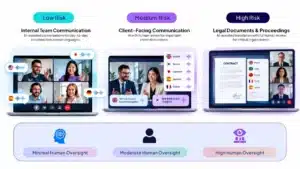
The strongest legal workflows are not simply “AI translates everything”. They are structured around different levels of risk.
Routine conversations, meeting discussions and general internal communication may be suitable for AI-assisted interpretation with standard monitoring.
Client-facing correspondence or matter-specific discussions may benefit from AI assistance followed by professional review where necessary.
Contracts, court filings, legal opinions, regulatory submissions & other legally consequential documents – all of them may require qualified human translation and specialist review.
This risk-based approach allows firms to gain efficiency. This is done without treating every piece of legal content as if it carries the same level of consequence.
Before introducing AI translation into a legal workflow, firms should evaluate more than language quality.
Understand how the platform processes, stores & protects information before allowing sensitive material into the system.
Law firms should review security controls, retention policies, access controls and contractual protections as part of vendor due diligence.
Fluent language does not automatically mean legally accurate communication.
The system should be assessed on whether it preserves meaning, context, terminology and intent rather than simply producing grammatically correct sentences.
Define when human review is mandatory. A clear review policy helps lawyers understand where AI can be used independently for communication support and where qualified professionals must validate the output.
Firms should maintain approved terminology for recurring legal concepts, client names, organisations and specialist practice areas.
Consistency becomes particularly important when multiple lawyers and languages are involved in the same matter.
AI adoption should align with the firm’s professional obligations and applicable data protection requirements. This is particularly important as AI becomes embedded across more legal workflows.
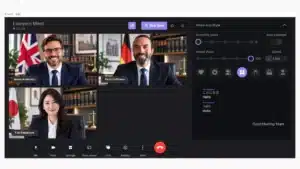
The value of AI becomes clearer when viewed as part of an existing legal workflow rather than as a standalone translation function.
Consider an international law firm handling a corporate matter involving teams in the UK, Germany and Japan.
The firm could use AI-powered multilingual communication to:
The lawyers remain responsible for legal analysis and decisions. AI simply makes the communication layer faster and more accessible.
That distinction is important. The objective is not to make legal practice autonomous. It is to make international collaboration less dependent on language.
For law firms working across jurisdictions, multilingual communication often needs to happen in real time. This should be done across meetings, client interactions & wider collaboration.
emotii provides AI-powered multilingual communication solutions designed to preserve meaning, intent, tone and cultural nuance across languages.
emotii Meetings enables global teams to communicate in real time across 90+ languages. For an international law firm, this can support multilingual meetings while also providing meeting recordings, transcripts and AI-generated summaries.
That means the value of the conversation does not end when the meeting does.
During a multilingual client meeting, participants can communicate in their preferred languages. The system interprets the conversation in real time. This can be particularly useful for international consultations, cross-border teams and global client relationships.
Legal teams often need to revisit what was discussed.
AI transcription can make meeting content easier to search, review and summarise, subject to the firm’s own confidentiality, retention and governance policies.
For larger legal events, webinars and international conferences, emotii Conference enables presenters and participants to communicate across 90+ languages. This can help global firms make seminars, client events and professional gatherings more accessible to international audiences.
Legal communication rarely happens through meetings alone. Depending on the firm’s requirements, emotii also provides multilingual capabilities across websites, videos, presentations, chatbots and APIs.
For example, emotii Website AI Studio can help firms make their website accessible across 126+ languages, while emotii Video AI Studio supports multilingual video adaptation across 90+ languages.
This creates a broader opportunity: instead of solving one language barrier at a time, firms can build multilingual communication into multiple client and collaboration touchpoints.
The right platform should fit the firm’s existing workflow rather than force lawyers to redesign how they work.
Look for:
The goal is not to find the tool that translates the most languages. It is to find the platform that can support multilingual communication responsibly within the firm’s actual operating environment.
AI delivers the most value when firms establish clear boundaries around how it is used.
Create clear guidance for where AI translation and interpretation can be used and where human translation is mandatory.
Do not allow employees to use unapproved consumer AI tools for confidential client information.
AI can interpret communication, but legal professionals remain responsible for legal advice, conclusions and decisions.
Set higher review requirements for high-risk content, sensitive matters and legally consequential communications.
Maintain approved terminology for practice areas, recurring legal concepts, client names and internal language.
Lawyers and support staff should understand both what AI tools can do and where their limitations lie.
The 2026 American Bar Association report notes that training gaps remain a significant barrier to responsible firm-wide AI adoption.
The direction of travel is clear: AI is becoming embedded in legal work.
But the more useful question is not whether AI will replace legal professionals. It is how firms can use it to remove repetitive friction from professional workflows.
For multilingual legal teams, that friction can be substantial.
Every delayed interpretation, misunderstood message, inaccessible meeting or language-dependent workflow adds another layer of operational complexity.
AI-powered interpretation and translation can reduce that friction while keeping legal judgement where it belongs: with qualified professionals. As international work increases, the ability to communicate effectively across languages becomes part of the firm’s service experience.
Language should not become the hidden bottleneck in international legal work.
AI translation can help law firms communicate faster with international clients, collaborate across jurisdictions, make meetings more accessible and reduce the operational friction associated with multilingual communication.
But legal translation is not simply a language problem. Accuracy, confidentiality, context, terminology and professional responsibility all matter.
That is why the most effective approach is not AI instead of legal expertise. It is AI working alongside it. For firms looking to build more accessible, efficient and globally connected workflows, exploring an AI-powered multilingual communication platform such as emotii can be a practical next step.
The future of legal communication will not necessarily be about speaking every language. It may be about having the technology to make every conversation understood.
Yes. AI translation can support meetings, client communication, internal collaboration, captions, transcripts and other multilingual workflows. However, firms should define appropriate use cases and maintain human review for legally consequential content.
AI should not be treated as a replacement for qualified legal translators. Legal documents often require specialist knowledge, jurisdictional understanding and careful interpretation. AI is better positioned as a productivity and communication tool that supports human professionals.
That depends on the platform and its security architecture. Firms should assess data retention, encryption, access controls, privacy policies, compliance certifications and contractual protections before using AI with confidential information.
AI can provide real-time interpretation and multilingual captions, allowing participants to communicate more naturally. Depending on the platform, meetings can also be transcribed, recorded and summarised afterwards, subject to the firm’s policies and applicable requirements.
Contracts, court filings, legal opinions, regulatory submissions, evidence and other legally consequential material should receive appropriate professional review. The level of review should depend on the legal and regulatory risk involved.
Legal meaning can depend on terminology, jurisdiction, tone and the surrounding discussion. A word-for-word translation may be linguistically correct but fail to communicate the intended legal meaning. Context-aware systems can help reduce this risk, but professional judgement remains essential.